
PSYCHERNETICS INTEGRATED INTELLIGENCE ASSESSMENT · PIIA
How Integrated Is Your Intelligence?
Discover how four capacities of integrated human intelligence are currently organised within you.
Intelligence is usually measured by what we can solve, remember or understand.
PIIA begins with a different question: how available is your intelligence when perception, emotion, meaning and judgement have to work together?
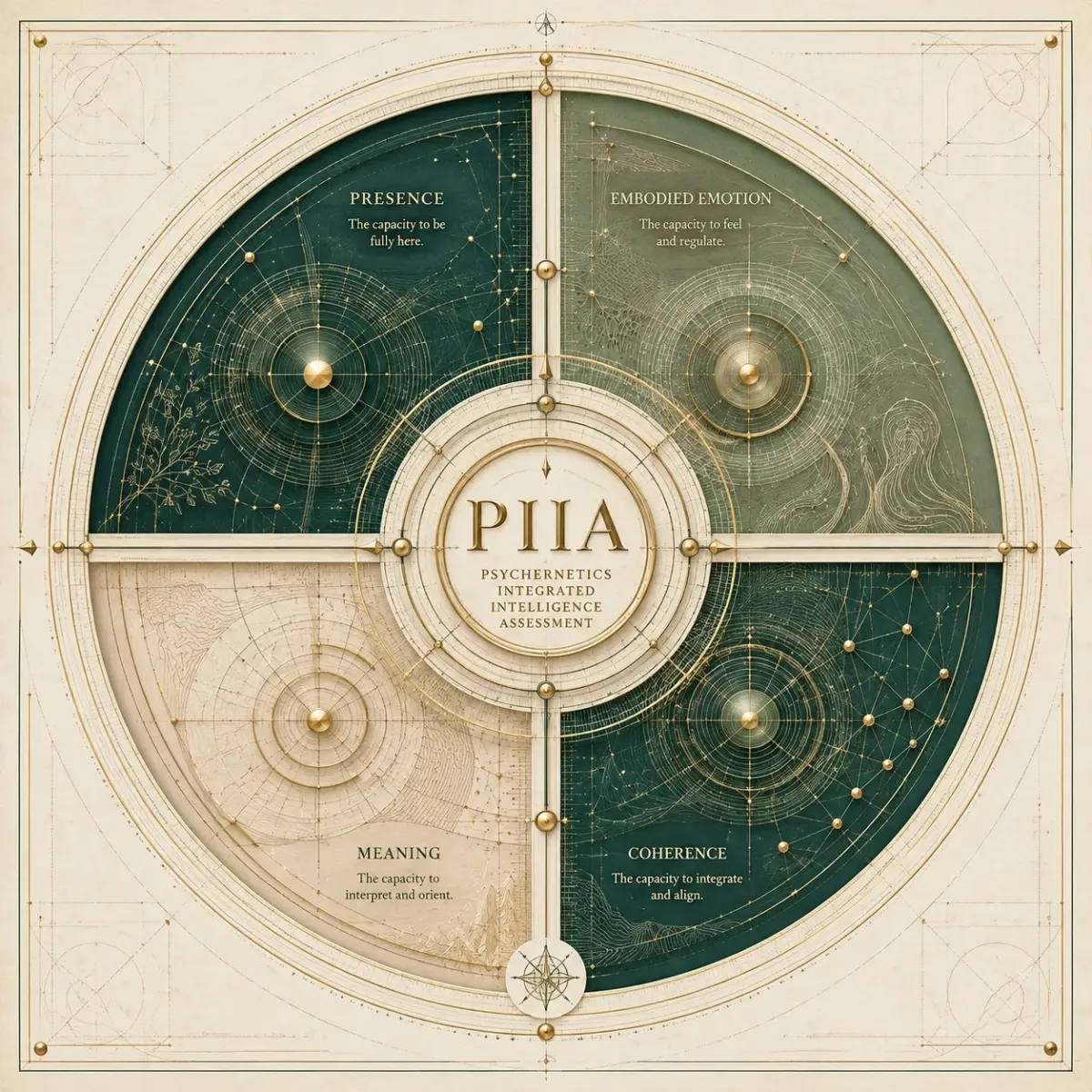
Through 32 carefully constructed questions, PIIA explores four capacities at the heart of the Psychernetic model of integrated intelligence: Presence, Embodied Emotion, Meaning and Coherence.
Your personalised profile reveals where these capacities appear strongly available, where they may become less consistent, and how the pattern between them may shape the way you perceive, interpret, judge and act.
32
Questions
Around 5 Minutes
Immediate Personal Results
No Email Required
A DIFFERENT QUESTION ABOUT INTELLIGENCE
Intelligence Is More Than What You Can Do
For more than a century, intelligence has largely been approached through capability: what a person can reason through, remember, solve, understand or learn.
Those capacities matter. But they do not answer another important question.
How much of your intelligence remains available when you actually need to use it?
Under pressure, attention can narrow. Emotional signals can be ignored or become overwhelming. Interpretations can harden into certainty. Complexity can fragment judgement. A person may possess considerable intellectual ability while having less access to the wider architecture required to use that ability coherently.
Psychernetics approaches intelligence from this perspective.
Rather than asking only what the mind is capable of, it examines the conditions through which intelligent functioning becomes available and integrated in lived experience.
The Psychernetics Integrated Intelligence Assessment (PIIA) was developed by Dr Tom Barber as an applied assessment of the Psychernetic model of integrated human intelligence. It provides an initial way of exploring that architecture.
The question is not simply how intelligent you are.
It is how available your intelligence is when it matters.
THE PSYCHERNETIC EQUATION
Four Capacities. One Integrated Architecture
Psychernetics proposes that intelligent functioning depends not upon a single faculty, but upon the relationship between four capacities that allow us to remain in contact with experience, receive information from within it, understand what it means and organise that understanding into coherent judgement and action.
01. PRESENCE

The capacity to remain in contact with what is actually happening.
Presence creates the attentional space in which experience can be noticed before reaction, assumption or automatic interpretation determines what follows.
02. EMBODIED EMOTION
The capacity to receive emotional and bodily experience as information.
Embodied Emotion allows internal signals to contribute to understanding without requiring either their suppression or their unquestioned authority.
03. MEANING
The capacity to recognise and examine how experience is being interpreted.
Meaning allows assumptions to become visible, alternative perspectives to remain possible and understanding to change when new information requires it.
04. COHERENCE
The capacity to integrate complexity into organised judgement and action.
Coherence allows different sources of information, competing demands and unresolved tensions to remain in relationship long enough for deliberate judgement to emerge.
I = P + E + M + C
Integrated Intelligence = Presence + Embodied Emotion + Meaning + Coherence
The Psychernetic Equation is not a mathematical calculation of intelligence. It is a model of integration. Each capacity contributes something different, but intelligent functioning depends upon their relationship as a whole.
THE ASSESSMENT
What Does PIIA Explore?
PIIA translates the Psychernetic Equation into a structured self-assessment of how available the Four Capacities appear to be within your current pattern of functioning.
Across 32 carefully constructed statements, you are invited to consider how you typically respond to situations involving attention, emotional information, interpretation, uncertainty, complexity and judgement.
The assessment does not attempt to measure intelligence in the conventional sense, nor does it assign you a personality type.
Instead, it explores the current availability of four capacities associated with integrated intelligent functioning.
32
Questions
Eight items explore each of the Four Capacities.
Around 5 Minutes
Respond according to how you generally function, rather than how you think you should.
Four Capacity Results
Each capacity is interpreted independently rather than collapsed into a single overall score.
Immediate Profile
Receive your Integrated Intelligence Profile as soon as you complete the assessment. No email address is required.
Understanding Your Results
Rather than labelling capacities as good or bad, PIIA describes their apparent availability within your current response pattern.
CONSTRAINED
The capacity may currently be less consistently accessible, particularly under conditions that place demands upon it.
EMERGING
The capacity appears available in some circumstances, while becoming less reliable in others.
AVAILABLE
The capacity appears generally accessible and able to contribute reliably to intelligent functioning.
STRONGLY AVAILABLE
The capacity appears highly accessible within your current response pattern, while remaining sensitive to context and pressure.
These are developmental descriptions, not fixed identities.
PIIA provides a snapshot of your current self-reported pattern. It is designed to support reflection and development, not to provide a clinical diagnosis or a definitive measure of intelligence.
WHAT YOUR PROFILE CAN REVEAL
See More Than a Score
The value of PIIA is not in discovering whether you are “high” or “low” in intelligence.
It is in seeing where the architecture supporting your intelligence appears readily available, where it may become less reliable, and how differences between the Four Capacities may help explain patterns you already recognise in yourself.
What becomes visible is not a judgement of your ability, but a more detailed picture of how that ability is currently organised and available to you.
PIIA Does Not Give You a Type. It Reveals a Configuration.
Each of the Four Capacities is assessed independently across four states of availability. Together, they can form:
Capacities
States
Possible Configurations
Your profile can help you:
Recognise where your intelligence may become less available under pressure
You may think clearly in ordinary circumstances yet find that attention, interpretation or judgement changes when complexity, uncertainty or emotional intensity increases.Understand why being capable does not always translate into clear judgement
PIIA can reveal differences between the capacities you possess and how consistently they remain available when they need to work together.See patterns that are difficult to notice from inside them
Automatic reactions, emotional signals, established interpretations and premature certainty can all influence judgement before we recognise that they are doing so.Identify where development may have the greatest value
Rather than trying to improve everything at once, your profile can highlight capacities whose greater availability may strengthen the wider architecture.Develop a more precise language for understanding your own functioning
Presence, Embodied Emotion, Meaning and Coherence provide a framework for examining experiences that can otherwise feel vague, contradictory or difficult to articulate.
The question is not simply how intelligent you are.
It is how available your intelligence is when it matters.
YOUR PROFILE
Ready to See Your Pattern?
There is no ideal PIIA profile and no set of answers you should be trying to produce.
As you respond, think about how you typically function across the different situations that make up your everyday life, rather than focusing on one particular setting. This might include conversations, decisions, work, relationships, moments of pressure or periods of uncertainty.
Answer according to what tends to be true for you, rather than how you would ideally like to be. Try not to overanalyse individual statements. Choose the response that most closely reflects your experience and continue.
32 questions · Around 5 minutes · Five response options per question
Your results across the Four Capacities, together with your personalised interpretations, will appear immediately after completion.
No email address is required to take PIIA or receive your results.
Begin PIIA-1
The Psychernetics Integrated Intelligence Assessment (PIIA) was developed by Dr Tom Barber as an applied assessment of the Psychernetic model of integrated human intelligence.

Psychernetics develops applied human intelligence for an AI-mediated world. Grounded in psychology and systems thinking, it restores clarity, composure, and internal sovereignty under pressure. This is not motivation. It is architecture. Reclaim authorship. Think deeper. Lead deliberately.
CONTACT US
+44 (0)204 5424497
Psychernetics Ltd
71-75 Shelton Street
Covent Garden
London, WC2H 9JQ
Opening Hours: Monday till Friday 09.00 to 17.00
LEGAL INFORMATION


Copyright 2026 Psychernetics Ltd. All rights reserved. Psychernetics® is a registered trademark of Dr Tom Barber.