
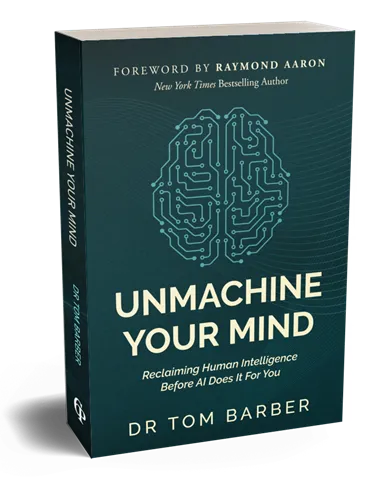
UNMACHINE YOUR MIND
Reclaiming Human Intelligence Before AI Does It For You
Dr Tom Barber
Founder of Psychernetics®
The Amazon #1 Bestselling book that introduced the Psychernetics framework
A Question for the Age of Artificial Intelligence
“The question is not whether machines can think, but whether humans will continue to think deeply enough to remain fully human.”
Artificial intelligence is advancing at extraordinary speed. Systems that once seemed experimental are now embedded in everyday life, shaping how we search, decide, communicate, and even how we understand ourselves.
Yet the most profound question raised by this technological transformation is not about machines.
It is about us.
What happens to human intelligence when thinking becomes externalised, attention becomes fragmented, and increasingly sophisticated systems begin to anticipate our decisions before we have consciously made them?
Unmachine Your Mind explores this question directly. It is the book that introduced the ideas that would later evolve into the Psychernetics system and the experiential starting point in Psychernetics through Compass.
Where Psychernetics Began
Long before Psychernetics developed into a structured framework, introduced through Unmachine Your Mind and brought into practice through its first programme, Compass, it began with a question that emerged from three decades of clinical work.
Working as a psychotherapist and trauma specialist, Dr Tom Barber observed a growing shift in how people relate to their own thinking.
As technology accelerated and information expanded, many people were becoming more connected to machines and less connected to their own inner architecture of attention, reflection, and meaning.
Unmachine Your Mind emerged from this observation.
The book proposes that we are living through what Tom calls the Cognitive Crisis: a moment in human history where technological intelligence is expanding rapidly while human depth risks becoming thinner.
Rather than resisting technology, the book asks a deeper question.
How can human intelligence evolve so that it remains conscious, integrated, and sovereign in an age of intelligent machines?
The answer offered in the book becomes the foundation of Psychernetics, a system designed to help individuals develop a deeper, more integrated relationship with their own minds.
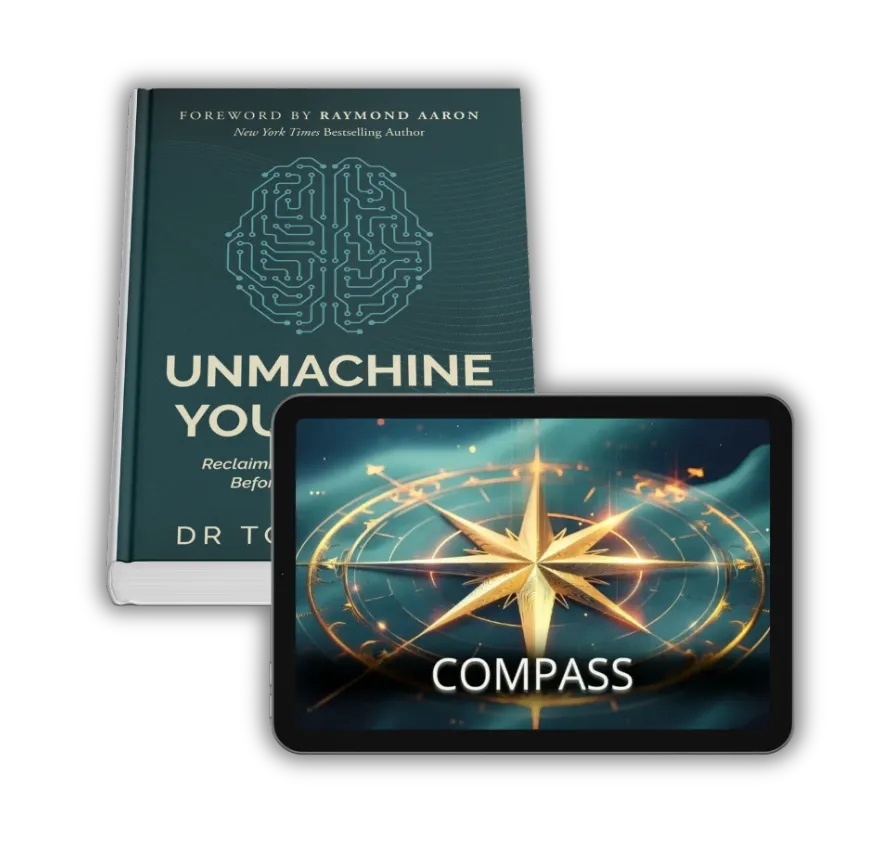
You can explore the full Psychernetics framework that emerged from this work before accessing the book.
About the Book
Unmachine Your Mind: Reclaiming Human Intelligence Before AI Does It For You explores how artificial intelligence is reshaping not only the external world, but the internal landscape of human cognition.
Drawing on psychology, philosophy, systems thinking, and decades of therapeutic practice, the book examines the psychological and existential consequences of living alongside increasingly intelligent machines.
Rather than presenting a critique of technology, the book offers something more constructive: a new way of understanding human intelligence itself. This perspective is developed further within the Psychernetics framework, where intelligence is approached as an integrated system of attention, emotion, meaning, and coherent self-direction, capable of remaining stable and deliberate even under conditions of increasing complexity and cognitive pressure.
Within its pages readers will explore:
• How artificial intelligence is quietly altering the way we think and process information
• Why the speed of modern life fragments attention and weakens deep reflection
• The difference between algorithmic intelligence and embodied human understanding
• Why emotion, meaning, and lived experience remain essential dimensions of intelligence
• The need for internal systems that allow human thinking to remain integrated and sovereign
• The foundations of the Psychernetic Co-Pilot, a framework for conscious self-leadership in a technological world
These ideas form the basis of the Psychernetics model and are explored further throughout the Insights series.
The book ultimately argues that the future of humanity will not be determined by machines alone, but by whether humans choose to cultivate the depth of awareness that technology cannot replicate.
Inside Unmachine Your Mind
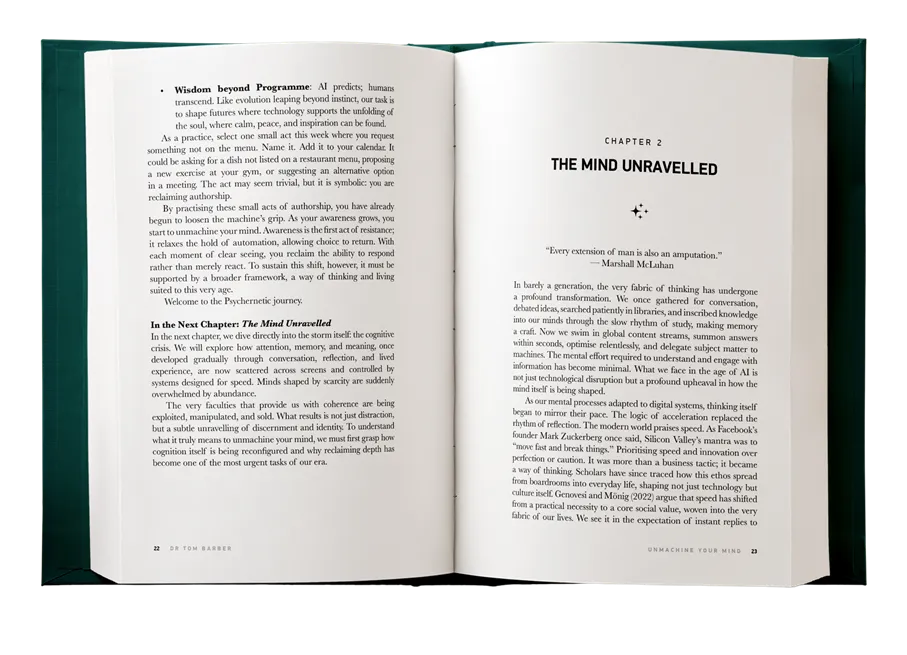
Chapter 1
In the Mirror of the Machine
Modern life exposes the human mind to an unprecedented volume of information. This opening chapter explores how digital acceleration and algorithmic environments reshape attention, perception, and identity, and why reclaiming cognitive sovereignty has become essential.
Chapter 2
The Mind Unravelled
What is the difference between human cognition and machine processing? This chapter explores layered consciousness, reflective awareness, and the complexity of human thinking compared with algorithmic systems.
Chapter 3
The Illusion of Intelligence
Intelligence alone is not enough. This chapter investigates the limitations of purely analytical thinking and explores why emotion, meaning, and subjective experience remain essential dimensions of wisdom.
Chapter 4
The Crisis of Being
In a world focused on optimisation and productivity, deeper questions of meaning often disappear. This chapter explores the existential dimensions of modern life and the human need for purpose, presence, and direction.
Chapter 5
The Forgotten Depths
Human intelligence is rooted in the body as much as in the mind. Drawing on trauma science and embodied psychology, this chapter explores emotional memory and the deeper intelligence of feeling.
Chapter 6
The Divergent Horizon
As digital culture pushes toward speed and standardisation, neurodivergent ways of thinking may offer unique advantages. This chapter explores ADHD, autism, and other divergent cognitive styles as sources of creativity and depth.
Chapter 7
Grokking the Machine
True understanding cannot be simulated. This chapter examines embodied cognition, mirror neurons, and the difference between knowledge that is lived and knowledge that is merely processed.
Chapter 8
Becoming Psychernetic
Here the central philosophy of Psychernetics begins to take shape, redefining intelligence as integration rather than calculation, beginning with the Psychernetic Equation.
.
Chapter 9
The Architecture of the Inner Co-Pilot
This chapter introduces the Co-PILOT framework, a structured approach to developing conscious self-leadership and psychological sovereignty.
Chapter 10
The Future Human and the Conscious Horizon
The book concludes by imagining a future in which technology and human depth evolve together. The challenge of the coming decades will not simply be technological advancement, but the conscious evolution of human awareness.



Urgently Needed
"A way to take back control of our own minds. A timely reminder that staying sharp and fully human in the age of AI is a conscious choice."
– Theo van Dort - Bali
Founder of Communitee.AI

Hard-Won Wisdom
"This isn’t armchair philosophy; it’s wisdom that lands in the body. A powerful reminder that depth is something the machine cannot replicate."
– Gill Moakes - UK
International Business Coach & Leadership Mentor

Profoundly Uplifting
“A timely and urgent vision for the age of artificial intelligence. A guide to reclaiming presence in a world determined to automate it.”
Raymond Aaron - Canada
New York Times Bestselling Author
About the Author

Dr Tom Barber is a UKCP-registered psychotherapist, trauma specialist, international trainer, and founder of the Psychernetics framework.
With nearly three decades of clinical and teaching experience across the United Kingdom and internationally, his work explores the intersection of psychology, philosophy, systems thinking, and human development in an age increasingly shaped by artificial intelligence.
Further detail on his background and the development of Psychernetics can be found on the About page.
Through his writing and teaching, Dr Barber examines how individuals can cultivate deeper awareness, emotional integration, and cognitive sovereignty in a rapidly changing technological world.
From Understanding to Practice
Reading introduces ideas.
Recognising how those ideas relate to your own experience brings them closer.
Unmachine Your Mind explores the questions that gave rise to Psychernetics, a framework concerned with understanding and developing human intelligence in the age of AI.
Two practical resources take that exploration further.
PIIA-1 helps you recognise your current patterns of intelligence availability.
Compass helps you develop the capacities behind them.
Together, they offer a progression from understanding human intelligence to recognising and strengthening its availability in your own life.
Discover Your Intelligence Availability with PIIA-1

How available is your intelligence when you need it most?
The Psychernetics Integrated Intelligence Assessment (PIIA-1) is a free, five-minute assessment exploring four essential human capacities:
Presence, Embodied Emotion, Meaning and Coherence.
Through 32 reflective questions, you'll discover your current configuration of intelligence availability and gain insight into how these capacities operate in your everyday experience.
There are no personality types to fit into and no intelligence scores to achieve. PIIA offers a starting point for understanding how your intelligence becomes available, and where further development may be valuable.

Begin Compass
Understanding your current patterns is a beginning. Developing your capacity to respond differently is the next step.
Psychernetics Compass is a structured developmental programme designed to help you strengthen the four capacities explored in Unmachine Your Mind and PIIA-1.
Through guided lessons, practical exercises, reflective inquiry, architectural diagrams, audio sessions and daily application, Compass helps you translate the Psychernetics framework into lived experience.
Its purpose is not simply to give you more knowledge, but to help you remain more present, emotionally connected, discerning and coherent when life becomes demanding.
The Thetawave Orientation
The Thetawave Orientation remains an important practice within the wider Psychernetics framework.
Originally introduced alongside Unmachine Your Mind, it provides a guided orientation exercise for settling attention, reducing internal noise and preparing the mind for deeper reflection.
It continues to complement both the book and Compass as a practical resource for returning to presence and clarity.


Experience the Thetawave Orientation
Readers of Unmachine Your Mind are invited to experience the Thetawave Orientation, a guided audio session designed to help quiet internal noise and prepare the mind for deeper reflection.
Explore Psychernetics
Unmachine Your Mind introduces the philosophy.
PIIA-1 makes your current configuration visible.
Compass provides a pathway for development.
Together, they form an introduction to Psychernetics, a developing framework for understanding and strengthening human intelligence in the age of AI.

Psychernetics develops applied human intelligence for an AI-mediated world. Grounded in psychology and systems thinking, it restores clarity, composure, and internal sovereignty under pressure. This is not motivation. It is architecture. Reclaim authorship. Think deeper. Lead deliberately.
CONTACT US
+44 (0)204 5424497
Psychernetics Ltd
71-75 Shelton Street
Covent Garden
London, WC2H 9JQ
Opening Hours: Monday till Friday 09.00 to 17.00
LEGAL INFORMATION


Copyright 2026 Psychernetics Ltd. All rights reserved. Psychernetics® is a registered trademark of Dr Tom Barber.