
Psychernetics
Psychernetics® is a psychological and cognitive framework for improving human intelligence in the age of artificial intelligence.
It combines principles from psychotherapy, systems thinking, and philosophy of mind to help individuals think more clearly, maintain internal coherence, and remain self-directed in increasingly complex environments.
A Framework for Human Intelligence in the Age of Artificial Intelligence
Psychernetics emerged from a simple but increasingly urgent question: what does it mean to think well when the external systems around us are becoming more intelligent, more persuasive, and more deeply woven into everyday life?
This question is explored more fully in Unmachine Your Mind.
We now live in conditions where information arrives faster than reflection, decision-making is increasingly shaped by algorithms, and many people experience a quiet but persistent sense that their own inner clarity is being diluted by speed, pressure, and cognitive overload.
This deeper shift is explored in more detail in Why Optimisation Is Not Enough: The Crisis of Being in the Age of AI, in the Insights series.
In such a climate, the challenge is no longer simply to know more, perform more, or optimise more efficiently. The deeper challenge is to remain internally coherent while living inside systems designed to capture attention, influence judgement, and accelerate reaction.
Psychernetics was developed by Dr Tom Barber as a response to that condition. It is an applied framework for strengthening human intelligence where intelligence is understood not as raw mental performance, but as the capacity to remain present, discerning, emotionally integrated, and psychologically self-directed in a world increasingly shaped by external intelligence.
It does not begin with motivation, productivity, or behavioural hacks. It begins with a more fundamental question: what kind of internal architecture allows a human being to remain clear, deliberate, and fully alive under modern conditions?
The foundations of this approach are explored in more depth in Unmachine Your Mind, where the psychological and philosophical basis of Psychernetics is laid out in full.
A Different Definition of Intelligence
One of the central propositions within Psychernetics is that intelligence must now be understood more broadly than cognition alone.
A person may be highly informed yet inwardly fragmented. They may think quickly yet remain disconnected from what they feel, driven by contradiction, overextended by external demand, or uncertain of what truly matters to them. In such cases, intellectual capacity exists, but intelligence in its fuller human sense is unstable.
Psychernetics describes this distinction as Available Intelligence: not simply the intelligence a person possesses, but how much of that intelligence remains available to them when it is actually needed.
This pattern is increasingly recognised even among high performers, as explored in Why Successful People Still Feel Mentally Fragmented.
Psychernetics defines intelligence through four interdependent dimensions:
Presence + Embodied Emotion + Meaning + Coherence
Presence refers to the capacity to remain psychologically available to the moment rather than being pulled continuously into distraction, urgency, or internal drift.
Embodied Emotion recognises that feeling is not an obstacle to intelligence but part of it. Emotion, when consciously integrated, becomes information rather than interference. The importance of this shift is explored further in Why Embodiment Matters More Than Ever in a Digital World
Meaning concerns direction. It is the ability to locate action within a wider structure of value, purpose, and significance rather than living reactively from demand alone.
Coherence is the alignment of thought, feeling, language, and behaviour. It is what allows intelligence to become trustworthy, because the inner system is not divided against itself.
When these dimensions operate together, intelligence becomes more than performance. It becomes a form of organised human presence, one capable of meeting complexity without collapsing into noise. This distinction between surface knowledge and deeper understanding is examined in What Does It Mean to Grok? Deep Understanding in the Age of AI.
This definition forms the basis of the Psychernetic Equation, the model of integrated human intelligence at the heart of Psychernetics. The availability of these Four Capacities can be explored through PIIA, the Psychernetics Integrated Intelligence Assessment, while Compass provides a structured pathway for developing them in practice. These ideas are examined further throughout the Insights series.
Why Psychernetics Had to Emerge
For much of modern history, intelligence has been measured through speed, memory, and output. Educational systems rewarded recall. Professional systems rewarded efficiency. Digital culture intensified both, creating an environment where quick answers often began to look like depth. As explored in AI Is Fast, But Human Thinking Was Never Designed for Speed, this shift has quietly redefined how intelligence itself is perceived.
Artificial intelligence has exposed the limits of that definition. Machines now outperform human beings in many of the areas once treated as proof of cognitive superiority: rapid retrieval, pattern recognition at scale, data synthesis, and technical prediction. If intelligence is reduced to speed alone, then human value becomes increasingly difficult to define in distinctly human terms.
Yet the most important dimensions of human intelligence were never fully captured by speed in the first place. The ability to remain psychologically steady in uncertainty, to feel emotion without being governed by it, to distinguish signal from noise, to act with meaning rather than impulse, and to hold complexity without fragmentation, these capacities are not mechanical, and they do not emerge automatically under pressure.
At the same time, the increasing pressure placed on attention and decision-making is examined in The Hidden Cost of Always Being “On”: Cognitive Overload in High Performers.
This is where Psychernetics begins. It proposes that the next stage of human development is not to compete with artificial systems on their own terms, but to deepen the forms of intelligence machines cannot embody: presence, embodied judgement, reflective depth, ethical coherence, and conscious authorship.
In that sense, Psychernetics is not a reaction against technology. It is a framework for ensuring that technological advancement does not quietly outpace human maturity.
Many of these themes are explored in applied form through the Insights section, where the implications of this shift are examined across leadership, attention, and modern life.
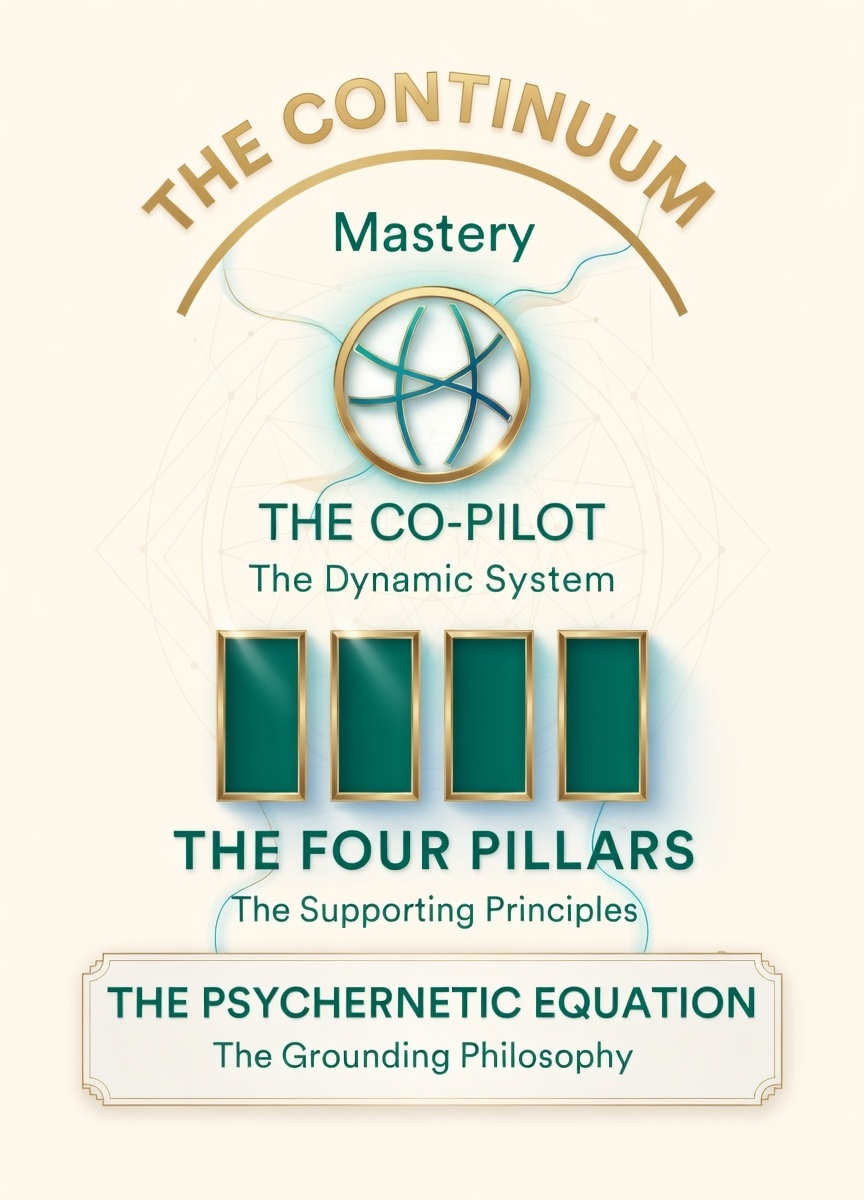
The Psychernetic Equation
At the foundation of the framework sits what is known as the Psychernetic Equation:
Intelligence = Presence + Embodied Emotion + Meaning + Coherence
This is not presented as a motivational formula, but as a foundational organising principle. It expresses the conditions under which human intelligence becomes durable rather than fragile.
Remove presence, and attention becomes vulnerable to fragmentation.
Remove embodied emotion, and decisions lose contact with deeper internal information.
Remove meaning, and effort becomes mechanical, often productive but directionless.
Remove coherence, and even strong ability begins to fracture under pressure.
The Equation matters because many contemporary forms of functioning reward partial intelligence while neglecting the whole. It is possible to appear successful while internally divided, highly capable while chronically overstimulated, productive while psychologically misaligned. The ability to think independently within this environment is explored further in Cognitive Sovereignty: The New Skill Nobody Is Teaching.
Psychernetics begins by correcting that imbalance. Before higher performance, before strategic clarity, before internal redesign, there must first be a stable foundation through which thought, emotion, identity, and action begin to speak the same language.
Only then can intelligence become something more than output. It becomes a reliable internal structure from which a person can think, decide, relate, and lead with depth.
The framework can be understood as layered rather than linear. Each level supports the next, allowing intelligence to deepen without losing structural coherence.
This equation is not intended to remain conceptual. It forms the foundation for practical work through which the architecture of integrated intelligence can be explored and developed. The Psychernetics Integrated Intelligence Assessment (PIIA) provides one way of beginning, translating the Four Capacities into a 32-item assessment that reveals how Presence, Embodied Emotion, Meaning and Coherence appear to be available within your current pattern of functioning.
From there, practical development can continue through Compass, the foundational developmental pathway within Psychernetics. Compass works progressively with the conditions through which the Four Capacities become more available under pressure, complexity and everyday life.
The Four Pillars of Psychernetics
If the Psychernetic Equation establishes the conditions under which intelligence becomes whole, the Four Pillars provide the stabilising principles that allow that wholeness to hold under real-world pressure.
They are not motivational habits, nor are they abstract ideals. They function as enduring disciplines of attention, perception, and self-organisation. Without them, even insight quickly becomes unstable. A person may understand what matters, yet still drift repeatedly into distraction, contradiction, emotional reactivity, or externally shaped thinking.
The Four Pillars were developed to prevent that drift. They create a framework through which intelligence remains anchored even when circumstances become complex, uncertain, or psychologically demanding.
Input Integrity concerns what enters and shapes the inner system. Every environment, conversation, digital stream, idea, expectation, and repeated exposure leaves a trace. Human beings are not neutral processors of information. What is repeatedly absorbed begins to organise mood, perception, and judgement. Psychernetics therefore begins with a disciplined awareness of inputs, not to encourage withdrawal from the world, but to restore discernment within it.
Loop Logic recognises that human experience is rarely linear. Thought, behaviour, emotion, and environment interact recursively, often reinforcing patterns long before they become conscious. A reaction today may carry yesterday’s unfinished interpretation. A habit may appear behavioural while being sustained by deeper emotional repetition. Psychernetics teaches people to observe these loops not with self-criticism, but with increasing precision, so that repetition becomes visible before it becomes destiny.
Signal Sovereignty refers to the capacity to distinguish one’s own authentic signal from the noise of external influence. Modern life constantly invites borrowed urgency, borrowed opinion, borrowed identity, and borrowed fear. Under such conditions, many people gradually lose trust in the quieter forms of knowing that arise through embodied reflection, emotional truth, and internal clarity. Signal Sovereignty restores that relationship, not as intuition detached from reason, but as a disciplined return to what remains inwardly true when pressure subsides. This becomes particularly relevant when viewed alongside emerging patterns in cognition explored in Neurodivergence, Pattern Recognition, and the Future of Human Intelligence.
Meaning Matrix gives structure to significance. Human beings do not live by information alone. They organise themselves around meaning, whether consciously or unconsciously. When meaning is weak, life often becomes efficient but hollow. When meaning is coherent, even difficult decisions acquire depth and proportion. Psychernetics treats meaning not as sentiment, but as an organising force that aligns values, action, and identity over time.
Together, the Four Pillars provide the conditions under which intelligence can remain stable rather than episodic. They do not remove uncertainty. They allow a person to remain internally organised while moving through it.
These principles are not theoretical. They are explored in practice through structured pathways within Psychernetics.
You can see how this develops in practice through the Psychernetic Path.
The Co-PILOT
Once the Psychernetic Equation establishes the foundation and the Four Pillars stabilise the structure, Psychernetics becomes operational through the Co-PILOT.
The Co-PILOT is the internal navigation system through which awareness becomes usable in real time. It is not a metaphor for self-help, nor simply a reflective exercise. It describes the inner process by which a person notices what is happening within them, interprets it accurately, and responds without surrendering authorship to impulse, habit, or external pressure.
Most people already experience moments when this internal function appears briefly. A pause before speaking when emotion rises. A recognition that a familiar reaction is beginning again. A subtle awareness that what appears urgent may not actually be true.
Psychernetics takes that intermittent capacity and develops it deliberately.
The reason this matters is simple. Modern life increasingly rewards reaction while quietly weakening reflection. Under cognitive load, emotional strain, digital acceleration, or relational pressure, the human system tends to default to old patterning unless a more conscious internal structure is present. This tension is explored further in Why Human Intelligence Still Matters in the Age of AI.
The Co-PILOT is that structure.
It enables a person to remain aware of physiological shifts before they become behavioural reactions. It sharpens objective observation so that mood, interpretation, and bias can be recognised without immediate identification. It strengthens the ability to interrupt patterns before they harden into action. It refines internal dialogue so that criticism, fear, urgency, and clarity can be distinguished rather than fused together.
Over time, the Co-PILOT also develops layered thinking, the capacity to perceive immediate experience while simultaneously recognising wider systems, relational dynamics, and deeper identity questions operating beneath the surface.
In Psychernetics, this matters because intelligence is not defined only by what a person knows or is capable of, but by how much of that intelligence remains available when complexity arrives.
The Co-PILOT therefore represents a practical form of self-leadership. Not rigid control, but conscious navigation.
A person does not become less human through this process. They become more fully available to their own humanity, with greater steadiness, greater discernment, and greater capacity to choose deliberately under pressure.
The Co-PILOT is developed experientially within Compass, where it becomes a practical means of strengthening awareness, pattern recognition and conscious authorship under real-world conditions.
Why Psychernetics Matters in an AI-Shaped World
The emergence of artificial intelligence has intensified a question that was already forming beneath modern life: what happens to human thought when external systems begin to think with us, for us, and increasingly ahead of us?
The visible conversation around AI often focuses on productivity, disruption, and automation. These are important concerns, but they do not reach the deeper psychological implications. Every major technological shift eventually changes not only what people do, but how they perceive, interpret, decide, and relate to themselves.
Artificial intelligence does this with unusual speed because it enters directly into language, judgement, planning, memory, and problem-solving, the very areas many people unconsciously associate with intelligence itself.
This creates a subtle risk. As external systems become more capable, internal effort can begin to weaken. Reflection may shorten because answers arrive quickly. Ambiguity may become less tolerated because prediction becomes easily available. Language may become increasingly fluent while personal authorship quietly thins beneath it.
Psychernetics addresses this not by opposing artificial intelligence, but by insisting that external intelligence must be matched by deeper internal development.
Machines can generate information. They cannot inhabit presence.
They can simulate language. They cannot experience embodied emotional truth.
They can optimise outcomes. They cannot determine what should matter in a human life.
They can assist decision-making. They cannot live with the moral, relational, and existential consequences of those decisions.
For this reason, the future will not be defined only by which technologies people adopt, but by whether human beings remain capable of bringing depth, coherence, and meaning to the systems they increasingly rely upon.
Psychernetics exists precisely at that threshold. It develops the human capacities that become more valuable, not less, as artificial intelligence becomes more present.
Its aim is not simply to help people function inside the age of AI. Its aim is to help them remain unmistakably human within it.
This perspective is explored in more detail through the Insights series, where the psychological implications of artificial intelligence are examined more directly.
This broader existential and psychological shift is also explored in Why Optimisation Is Not Enough: The Crisis of Being in the Age of AI.
From Framework to Practice


As shown on our homepage in the Psychernetic Path, Psychernetics is not intended to remain a conceptual model admired at a distance. Its purpose is realised only when the framework begins to alter how a person thinks, notices, decides, relates, and recovers orientation in daily life.
This is why the system moves deliberately from philosophy into practice. A principle only becomes transformative when it can be recognised under pressure, recalled during uncertainty, and applied when clarity is most needed.
For some people, that begins with a simple shift in attention: noticing the quality of what they consume, recognising how quickly thought becomes reactive, or observing how often important decisions are made from fatigue rather than coherence. For others, it begins in moments of greater intensity, during leadership pressure, relational conflict, internal contradiction, or the growing awareness that success and clarity are not always the same thing.
Psychernetics offers a structure through which those moments can be used differently. Instead of being absorbed unconsciously into old loops, they become opportunities for recalibration.
This practical dimension develops progressively.
Compass is the foundational developmental pathway within Psychernetics. Moving through Locating, Stabilising, Orienting, Authorship and Integration, it translates the framework into lived practice: helping participants recognise where they are operating from, remain psychologically available under pressure, understand the forces shaping their responses, recover conscious authorship, and integrate these capacities more consistently into everyday life.
Through Compass, the Psychernetic Equation, the Four Pillars and the Co-PILOT move from conceptual architecture into practical application. The emphasis is not simply on understanding Psychernetics, but on developing greater access to human intelligence when it is actually needed.
Code extends this work into the deeper patterns, assumptions and organising structures through which experience and behaviour become established over time.
Catalyst takes the work further into relational complexity, responsibility, identity and the application of Psychernetics where the consequences of judgement and action carry greater weight.
Each stage develops from the same underlying architecture while increasing the depth and complexity of its application. The aim is not progression for its own sake, but greater availability, coherence and conscious authorship across increasingly demanding conditions.
Insight can appear quickly. Durable development is different. It requires practice, repetition and sufficient integration for new capacities to remain available when circumstances become difficult.
An Emerging Body of Work
Psychernetics began as an attempt to articulate something increasingly visible across modern life: that many capable people were functioning at high levels externally while becoming progressively less anchored internally.
What first appeared clinically, in patterns of overwhelm, fragmentation, emotional disconnection, and cognitive strain, gradually revealed itself as part of a wider cultural shift. Technology was not simply changing behaviour. It was changing tempo, expectation, attention, and the conditions under which people were trying to remain psychologically coherent.
From that observation, the framework began to take shape.
The first full public articulation appeared through Unmachine Your Mind, where the deeper philosophical and psychological foundations were laid out in response to what the book describes as the cognitive crisis of the modern age.
From there, Psychernetics continued to develop beyond the book, not as a static theory, but as a living framework applied through structured programmes, professional dialogue, and increasingly broader contexts of human development.
It now stands as an evolving body of work concerned with a central question that will only become more important in the coming years: how does human intelligence deepen rather than thin under conditions of increasing artificial mediation?
That question extends far beyond personal development. It touches leadership, education, identity, decision-making, relational depth, and the future architecture of human maturity itself.
Psychernetics does not claim to answer that question finally. It offers a disciplined way of entering it.
And because the conditions that gave rise to it continue to intensify, the work itself continues to evolve.
Where Psychernetics Begins
Most people arrive at Psychernetics not because they are searching for another method, but because something in them already senses that speed alone is no longer enough.
They may be functioning well externally while carrying an increasing awareness that internal clarity has become harder to protect.
They may recognise that information is abundant, yet depth is harder to access. Or they may simply feel that much of contemporary life encourages reaction while leaving little room for reflection, meaning, or genuine authorship.
Psychernetics begins precisely there.
Not with urgency, and not with performance, but with the slower recovery of internal signal.
The work is not to become someone new in an artificial sense. It is to develop an inner structure strong enough that thought, emotion, judgement, and identity no longer fragment so easily under external pressure.
From that point, a different kind of intelligence becomes possible: one that is not merely informed, but grounded; not merely efficient, but coherent; not merely adaptive, but conscious.
The question is no longer simply how to succeed inside increasingly intelligent systems.
It is how to remain deeply human while doing so.
Begin Your Exploration of Psychernetics
Psychernetics can be approached from different directions, depending on what you want to understand, explore or develop.
To discover how available your intelligence is across the Four Capacities, begin with PIIA, the Psychernetics Integrated Intelligence Assessment.
To develop these capacities through a structured experiential process, explore Compass.
For the wider intellectual and philosophical foundations of the work, read Unmachine Your Mind.
Or continue exploring the ideas, research and applications shaping Psychernetics through Insights.

Psychernetics develops applied human intelligence for an AI-mediated world. Grounded in psychology and systems thinking, it restores clarity, composure, and internal sovereignty under pressure. This is not motivation. It is architecture. Reclaim authorship. Think deeper. Lead deliberately.
CONTACT US
+44 (0)204 5424497
Psychernetics Ltd
71-75 Shelton Street
Covent Garden
London, WC2H 9JQ
Opening Hours: Monday till Friday 09.00 to 17.00
LEGAL INFORMATION


Copyright 2026 Psychernetics Ltd. All rights reserved. Psychernetics® is a registered trademark of Dr Tom Barber.