About Psychernetics
Psychernetics® is best understood as a framework for human thinking and decision-making under modern conditions, particularly where attention, clarity, and internal coherence are under pressure from digital systems and artificial intelligence.
It was developed in response to a growing problem of modern life: the increasing difficulty of thinking clearly, deeply, and independently in an environment shaped by artificial intelligence, digital acceleration, and continuous cognitive interruption.
Many people today are highly informed, highly capable, and constantly engaged, yet often feel internally fragmented.
Attention is repeatedly pulled outward. Decision-making becomes reactive. Reflection is displaced by speed. Information increases, while clarity often weakens.
Psychernetics exists to address that condition directly, and can be explored in full through the Psychernetics framework.
It is a structured framework for cognitive sovereignty: a way of rebuilding the internal architecture required for clear thought, grounded judgement, and deliberate authorship in an age where mental environments are increasingly shaped by systems outside the self.
This is not an argument against technology. It is an argument for remaining fully human while living intelligently within it.
Psychernetics integrates psychology, systems thinking, philosophy of mind, embodied awareness, and practical cognitive development into a single working model. Its purpose is not simply insight, but internal structure: a way of thinking that can hold under pressure, complexity, and modern speed.
The central question is no longer whether artificial intelligence will influence human thought. It is whether human beings will remain authors of their own minds while it does. This question is explored more fully in Unmachine Your Mind, where the foundations of this work were first introduced.
Why Psychernetics Was Created
The modern world rewards speed, responsiveness, and constant adaptation. Yet the same conditions that make life efficient often make thought shallower.
Many intelligent adults now experience a subtle but important tension: they can process enormous amounts of information, yet struggle to maintain the depth required for discernment, perspective, and internally anchored judgement.
This is not a failure of intelligence. It is often a failure of structure.
Without an internal system for regulating attention, meaning, and interpretation, intelligence becomes vulnerable to overload. Thought becomes fragmented by urgency, comparison, and external demand.
Psychernetics was developed to answer that gap.
It offers a framework through which individuals can strengthen internal orientation, recognise distortion, and restore deliberate thinking without withdrawing from modern life.
Rather than adding more information, it helps organise the conditions under which information can be used wisely. Many of these themes are explored further through the Insights series, where the practical implications are examined across modern life.
What Makes Psychernetics Different
Psychernetics is not conventional self-development, and it is not motivational coaching. It does not begin with productivity, confidence, or performance techniques, although those often improve as a consequence of deeper structural work.
The focus is more fundamental: how attention is directed, how meaning is formed, how internal dialogue influences behaviour, and how perception itself becomes shaped over time.
Much of modern personal development works at the level of goals. Psychernetics works at the level beneath goals, where interpretation, emotional patterning, decision architecture, and internal authorship are formed.
This is why the work often feels different from both coaching and therapy. It is concerned not simply with what a person does, but with the structure from which action emerges.
The aim is not temporary motivation. The aim is durable internal command. The structure of this work can be understood more clearly through the Psychernetics model itself.
Founded by
Dr Tom Barber

Dr Tom Barber developed Psychernetics after more than three decades of work in psychotherapy, trauma treatment, emotional regulation, and human transformation.
His clinical and teaching work has included advanced therapeutic practice, international training, specialist trauma work, and long-term exploration of how people think, adapt, and reorganise themselves under pressure.
Across thousands of professional conversations, one pattern became increasingly clear: many capable people do not lack intelligence. What they often lack is a reliable internal structure through which intelligence can remain coherent when life becomes cognitively demanding.
Psychernetics emerged from that observation.
It brings together clinical depth, philosophical inquiry, systems thinking, and contemporary understanding of how digital culture is altering human cognition.
The result is a framework designed not simply to help people cope, but to help them think more deliberately, perceive more clearly, and remain internally directed in increasingly complex environments.
His work in this area is further developed through the Psychernetics framework.
The Book Behind the Framework
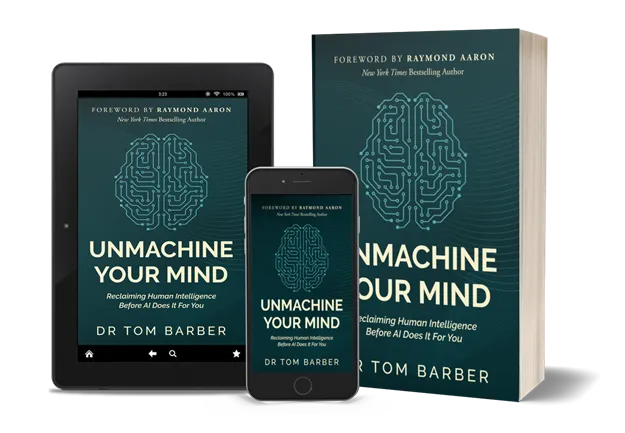
Many of the ideas that led to Psychernetics are explored in Unmachine Your Mind.
The book examines what happens when speed begins to replace depth, when reaction replaces reflection, and when modern systems increasingly shape the conditions under which people think.
It explores trauma, embodiment, neurodivergence, authorship, emotional intelligence, cognitive sovereignty, and the future of human intelligence in an AI-mediated world.
Where the book examines the architecture of the problem, Psychernetics provides a practical pathway for inhabiting the answer.
For many readers, the book becomes the intellectual entry point.
Psychernetics is where that inquiry becomes structured development. For many, the next step is to experience this work more directly through the Thetawave Orientation.
Who Psychernetics Is For
Psychernetics is designed for serious adults who recognise that clarity has become harder to protect.
It often resonates with founders, executives, professionals, clinicians, creatives, and individuals navigating complexity, transition, or sustained cognitive demand.
It is particularly relevant for those who sense that conventional self-development no longer reaches the level at which deeper change actually occurs.
The work tends to attract people who are not looking simply for encouragement.
They are looking for internal precision.
They want stronger thinking, better discernment, deeper orientation, and a more stable relationship with their own attention. Many of these perspectives are explored in greater depth through the Insights section.
The Psychernetic Path
The framework currently unfolds through a series of structured pathways, each designed to deepen internal clarity and cognitive sovereignty over time. This pathway begins with orientation. Many people begin with the Thetawave Orientation before moving into structured work.
Compass introduces the foundations of orientation, helping individuals begin to locate themselves more clearly within thought, emotion, and modern cognitive pressure.
Code, coming soon, develops the deeper internal architecture required for lasting change, strengthening perception, interpretation, and internal command.
Catalyst offers focused relational work for those requiring more direct strategic depth.
Each pathway reflects the same underlying principle:
Human intelligence is not defined only by what it knows, but by how consciously it can organise itself. Learn more in The Psychernetic Equation, the article introducing the foundational model behind Psychernetics.
Join the Story
Psychernetics begins with a simple proposition:
In a world increasingly designed to shape attention, one of the deepest forms of freedom may become the ability to direct it consciously.
So, where to next?
Psychernetics is not intended to remain conceptual. It becomes meaningful when its architecture begins to illuminate how you think, perceive, interpret and respond in real life.
You can explore the full framework here: Psychernetics
Begin with the ideas that helped give rise to the framework in Unmachine Your Mind
Or make it personal.
The Psychernetics Integrated Intelligence Assessment (PIIA) offers a way to explore how Presence, Embodied Emotion, Meaning and Coherence appear to be available within your own current pattern of functioning.
32 questions. Around five minutes. Your personalised profile immediately. No email required.
And when you are ready to move from seeing the architecture to deliberately developing it, Psychernetics Compass provides the structured developmental pathway through which that work begins.

Psychernetics develops applied human intelligence for an AI-mediated world. Grounded in psychology and systems thinking, it restores clarity, composure, and internal sovereignty under pressure. This is not motivation. It is architecture. Reclaim authorship. Think deeper. Lead deliberately.
CONTACT US
+44 (0)204 5424497
Psychernetics Ltd
71-75 Shelton Street
Covent Garden
London, WC2H 9JQ
Opening Hours: Monday till Friday 09.00 to 17.00
LEGAL INFORMATION


Copyright 2026 Psychernetics Ltd. All rights reserved. Psychernetics® is a registered trademark of Dr Tom Barber.