Psychernetics
Compass
Psychernetics
Compass

Strengthening Human Intelligence in an Age of Increasing Complexity
Compass is the first structured developmental pathway into Psychernetics, designed to strengthen awareness, stability, orientation, authorship and integration. It helps you think more clearly, respond more deliberately and navigate an increasingly complex world with greater confidence.
Rather than offering another collection of techniques or motivational strategies, Compass develops the underlying capacities from which clear thinking, sound judgement and intentional action emerge.
We live in an age of extraordinary technological intelligence.
Yet many people feel less internally clear than ever before.
Psychernetics begins with a different question.
Not how to think faster.
But how to think more consciously.
Compass is the first structured pathway into Psychernetics.

The Cognitive Crisis
Intelligent people have never had access to more information.
So why does clear thinking often feel harder than ever?
For much of human history, intelligence was limited by access to information.
Today, the opposite is increasingly true.
Information has become abundant. Knowledge is available within seconds. Artificial intelligence can generate answers almost instantly. We are more connected, more informed and more technologically capable than any previous generation.
Yet many people experience a very different internal reality.
Despite being capable, they struggle to think clearly beneath constant demands. Attention feels fragmented. Decisions become reactive. Reflection is displaced by urgency. The mind becomes increasingly occupied, yet often less organised.
They begin replying to one email while thinking about another. They reach for their phone without consciously deciding to. They move from meeting to meeting, conversation to conversation, carrying fragments of each into the next without ever fully arriving.
This is not simply a question of stress.
Nor is it adequately explained by burnout, poor motivation or a lack of resilience.
Something deeper appears to be happening.
Our external capacity has expanded dramatically, while the internal architecture required to organise perception, judgement and action has received comparatively little attention.
The challenge is not a lack of intelligence.
Increasingly, it is a lack of orientation.
Many intelligent people are remarkably capable, yet still lack a reliable framework for understanding what is happening within their own thinking.
When attention is repeatedly pulled in multiple directions, it becomes harder to distinguish what truly matters. Information accumulates faster than it can be integrated. Decisions become driven by immediacy rather than intentionality.
We respond because something feels urgent, rather than because we've had the space to decide whether it is important.
Over time, this can produce a subtle but significant form of cognitive fragmentation.
From the outside, life may appear successful.
Internally, however, coherence gradually begins to erode.
This is the condition from which Psychernetics begins.
Not because it rejects technology.
Nor because it opposes artificial intelligence.
But because human intelligence deserves to be understood with the same seriousness as the systems now being built around it.
A different question soon emerges.
If intelligence alone is no longer enough ...
What, exactly, is missing?

What if We've Been Solving the Wrong Problem?
For decades we have been encouraged to improve the way we think.
Perhaps the deeper challenge is that we have rarely been taught to understand the architecture from which thinking emerges.
Modern psychology has given us extraordinary insights into human behaviour.
Neuroscience has expanded our understanding of the brain. Philosophy has continued to ask profound questions about consciousness, identity and meaning. Cognitive science has explored perception, attention and decision-making. More recently, artificial intelligence has accelerated conversations about what intelligence itself might be.
Each has contributed something incredibly important.
Yet many people still experience the same underlying difficulty.
They understand more about themselves than ever before, yet often feel no more internally organised.
Many people can explain exactly why they react as they do, yet still find themselves repeating the same patterns in the moments that matter most.
Insight alone rarely creates lasting change.
Knowledge alone does not necessarily produce clarity.
Understanding a problem is not always the same as developing the capacities required to navigate it.
This is not a criticism of existing disciplines.
Rather, it points towards a different question.
What if the challenge is not simply what we think ...
... but the architecture within which thinking takes place?
Psychernetics does not begin by asking how to improve thinking.
It begins by asking how thinking is organised.
Most approaches focus on improving individual parts of human functioning.
Managing emotions.
Changing beliefs.
Building confidence.
Reducing stress.
Increasing resilience.
These can all be valuable. But they often address individual capacities in isolation.
It's rather like tuning one instrument beautifully while the rest of the orchestra remains out of time.
Psychernetics begins from a different premise.
Human intelligence is not simply a collection of separate abilities. It is an organised architecture.
Awareness influences stability.
Stability influences orientation.
Orientation influences agency.
Agency shapes intentional action.
Most of us have experienced the opposite. A poor night's sleep changes our emotional balance. Emotional reactivity narrows perception. Narrow perception leads to poorer decisions. One small disruption quietly affects everything that follows.
Over time, these capacities become integrated into the way a person meets the world. When one part of that architecture weakens, the effects are often felt elsewhere. When it strengthens, the benefits rarely remain isolated.
This is why Compass was never designed as another collection of techniques.
Nor as a programme of motivation or self-improvement.
It was designed as a structured developmental pathway for strengthening the underlying capacities from which clearer perception, wiser judgement and more intentional action naturally emerge.
Because perhaps the question has never been:
"How do I become a better version of myself?"
Perhaps it has always been:
"How do I better understand the architecture through which I experience, interpret and participate in my own life?"
That is the question from which Psychernetics begins.
Once the question changes ...
The search for answers changes with it.

Why Compass Exists
Compass was not created because the world needed another self-development programme.
It was created because an increasingly important question had no coherent answer.
Over many years of working with people from remarkably different walks of life, a consistent pattern began to emerge.
The circumstances varied.
Some were navigating trauma. Others were leading organisations, raising families, making complex decisions or simply trying to live more intentionally.
Many were intelligent, thoughtful and highly capable.
Despite those different circumstances, the same underlying difficulty repeatedly appeared. People often knew a great deal about themselves. They could describe their patterns, understand their histories and recognise their habits.
Even so, many still struggled to organise those insights into a reliable way of living.
They knew what they wanted to change. They often even knew why. But when pressure arrived, old patterns returned before conscious choice had a chance to respond.
Awareness alone was rarely enough.
Something seemed to be missing between insight and action. That observation became impossible to ignore.
As the pace of modern life accelerated, and as artificial intelligence, algorithmic environments and continuous digital stimulation began reshaping the way people attend, think and decide, the gap became even more apparent.
Notifications compete for attention. Algorithms compete for emotion. Endless information competes for judgement. Without realising it, many people begin living from interruption rather than intention.
The challenge no longer appeared to be a lack of information. Nor simply a lack of intelligence.
It became clear that what was missing was a coherent framework for understanding how the underlying capacities of human intelligence develop, interact and strengthen one another over time.
Existing disciplines each offered valuable pieces of the puzzle.
Psychology explored behaviour, emotion and cognition.
Philosophy examined meaning, consciousness and ethics.
Systems thinking revealed patterns, relationships and complexity.
Neuroscience expanded our understanding of the brain.
Each contributed something important.
In practice, however, people rarely experience their lives in separate categories. Thought influences emotion. Emotion influences perception. Perception influences behaviour. Human experience is always integrated.
What appeared to be missing was a developmental framework that explained how those capacities strengthen together, becoming progressively organised into a more intentional way of living.
That question became the foundation from which Psychernetics emerged.
Psychernetics did not begin with a technique.
It began with a question.
Not as an alternative to these disciplines.
But as an attempt to integrate what they reveal into a practical developmental framework for strengthening human intelligence itself.
Compass became the first practical expression of that work.
Not because it promises certainty.
Nor because it claims to solve every human difficulty.
But because every meaningful journey towards greater clarity begins with learning how to orient yourself within your own intelligence.
Once a framework begins to emerge ...
Development becomes possible.

A Different Kind of Learning Experience
Most courses are designed to transfer knowledge.
Compass was designed to develop capacities.
Much of modern education follows a familiar pattern.
Information is presented.
Concepts are explained.
Knowledge is transferred.
The learner understands more by the end than they did at the beginning.
There is obvious value in this approach.
Compass does something different.
Its primary purpose is not simply to increase what you know.
It is to strengthen the capacities through which you perceive, organise and apply what you know.
That distinction matters.
Knowing more does not automatically produce greater discernment.
Insight does not necessarily become action.
Understanding does not always become intentional living.
Development requires something more.
Rather than asking you to consume information as quickly as possible, Compass invites you into a slower, more deliberate process of observation, reflection and practice.
Each stage builds upon the one before it.
Recognition gradually becomes stability.
Stability creates the conditions for clearer orientation.
Orientation strengthens agency.
Agency becomes integrated into everyday life.
Nothing is rushed.
Nothing depends upon motivation.
The emphasis is not on finishing quickly, but on allowing these capacities to become more organised through repeated observation and deliberate application.
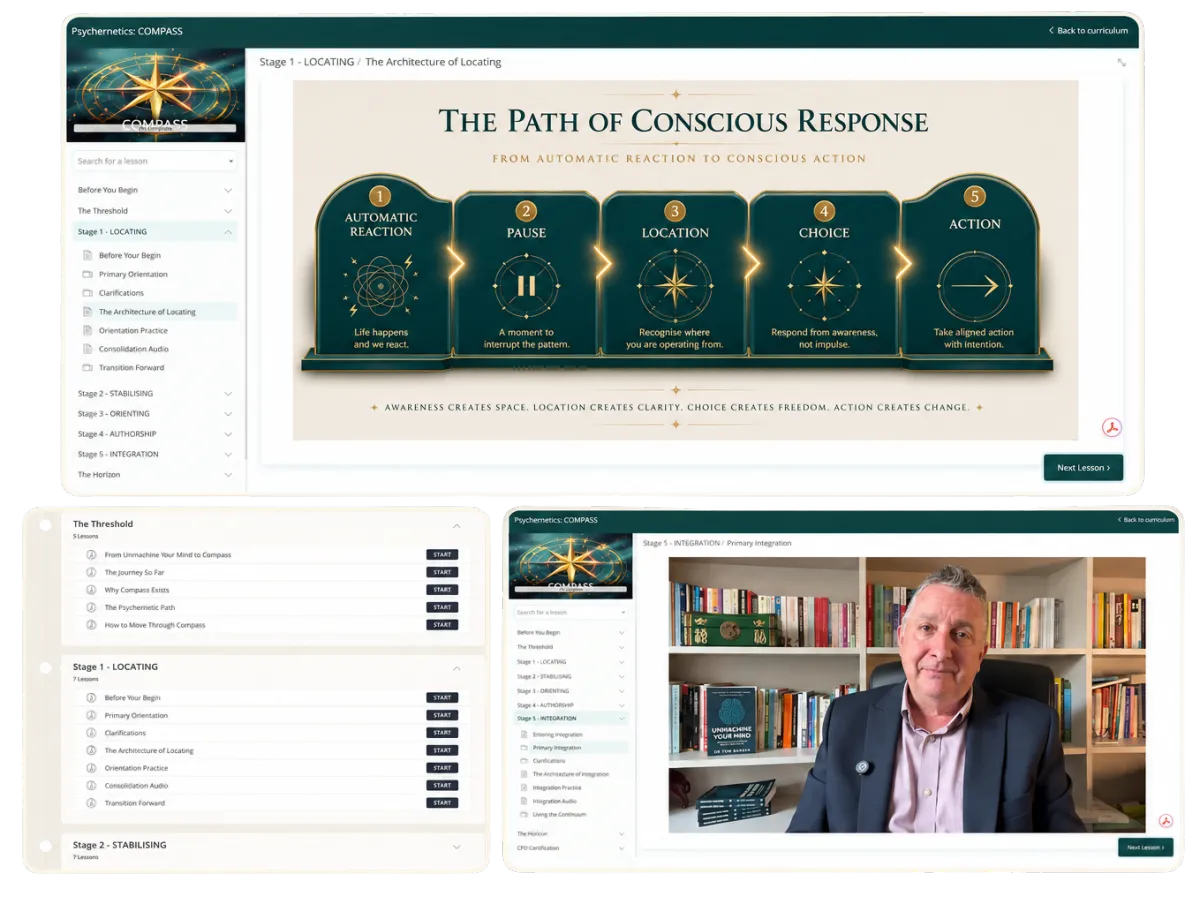
This is why Compass combines carefully structured teaching with practical exercises, guided audio integration, reflective inquiry and real-world application.
The videos introduce and explain the architecture.
The written lessons deepen understanding.
The practical exercises encourage application.
The guided audio lessons consolidate learning and reinforce integration beyond the screen.
The reflective inquiry helps bridge the gap between intellectual understanding and embodied experience.
Gradually, these different elements begin to reinforce one another.
The aim is not simply to complete a course.
It is to develop capacities that continue to strengthen long after the final lesson has been completed.
Compass was never designed to fill your mind with more information.
It was designed to strengthen the architecture through which information becomes wisdom.
The Compass Experience
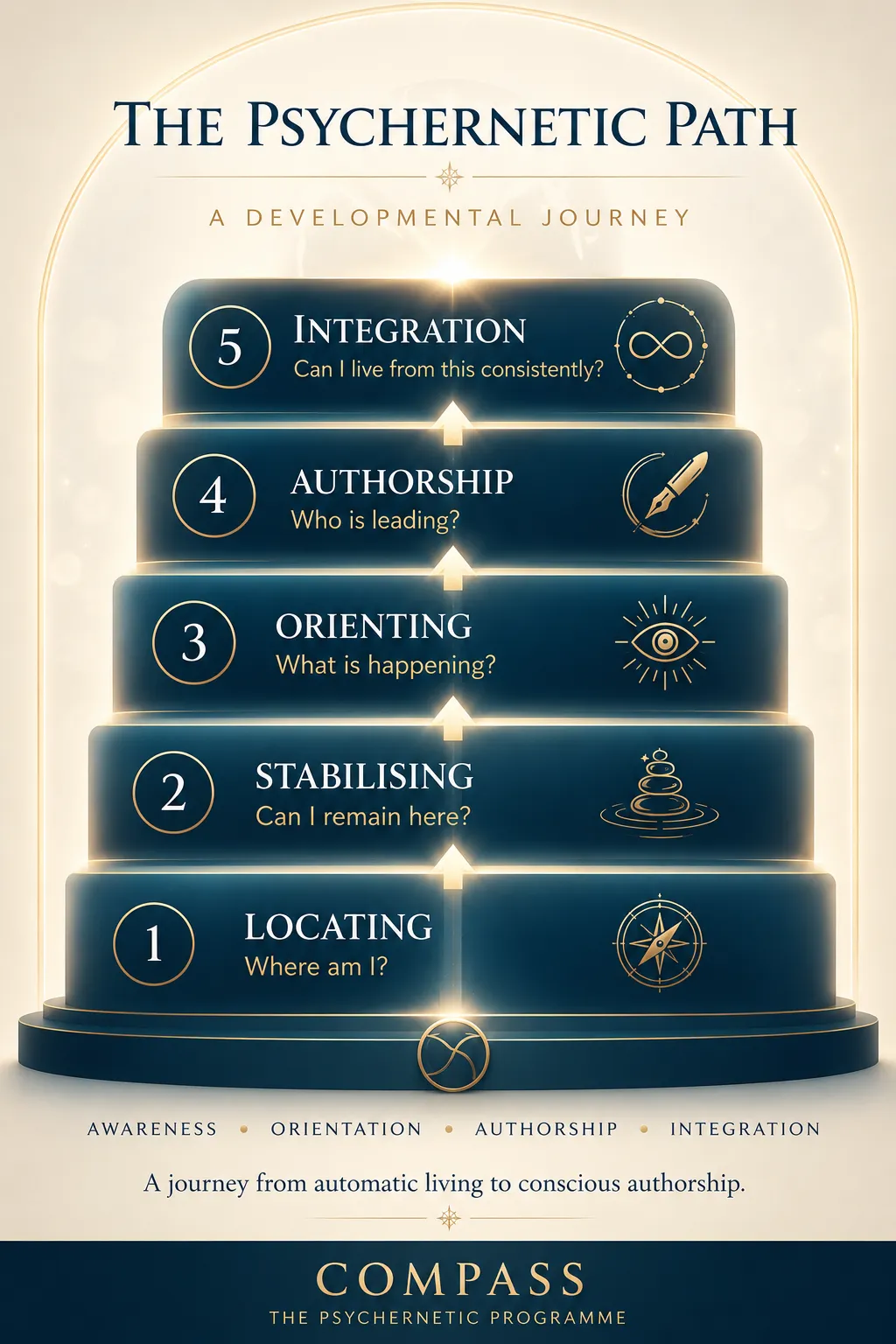
Rather than overwhelming you with large volumes of content, Compass has been intentionally designed as a progressive developmental pathway. Each stage introduces one central developmental question.
Where am I?
Can I remain here?
What is happening?
Who is leading?
Can I live from this consistently?
These are not simply topics to understand.
They become organising questions through which you begin to explore your own experience.
By the end of the programme, you will not simply have encountered new ideas.
You will have practised a different way of relating to yourself, your decisions and the world around you.
That is the distinction upon which Compass has been built from the beginning.
Development always begins quietly.
Capacity strengthens before confidence appears.

What Compass Develops
Most personal development programmes promise confidence, resilience, productivity or success.
Compass begins somewhere deeper.
Rather than pursuing outcomes directly, it strengthens the underlying architecture from which those outcomes naturally emerge.
As the architecture becomes stronger and more consistently available, perception becomes more reliable. Decisions become more deliberate. Emotional experience becomes easier to understand rather than simply endure. Meaning becomes clearer. Internal organisation begins to replace fragmentation.
This is why Compass goes beyond learning new ideas.
It strengthens the architecture through which intelligent functioning becomes organised and available in everyday life.
Every lesson, every practical exercise, every guided audio session, every reflective inquiry and every stage has been intentionally designed to strengthen that architecture through consistent practice.
Ultimately, the goal is not simply to know more.
It is to become capable of relating to yourself, your decisions and the world from a fundamentally different level of organisation.
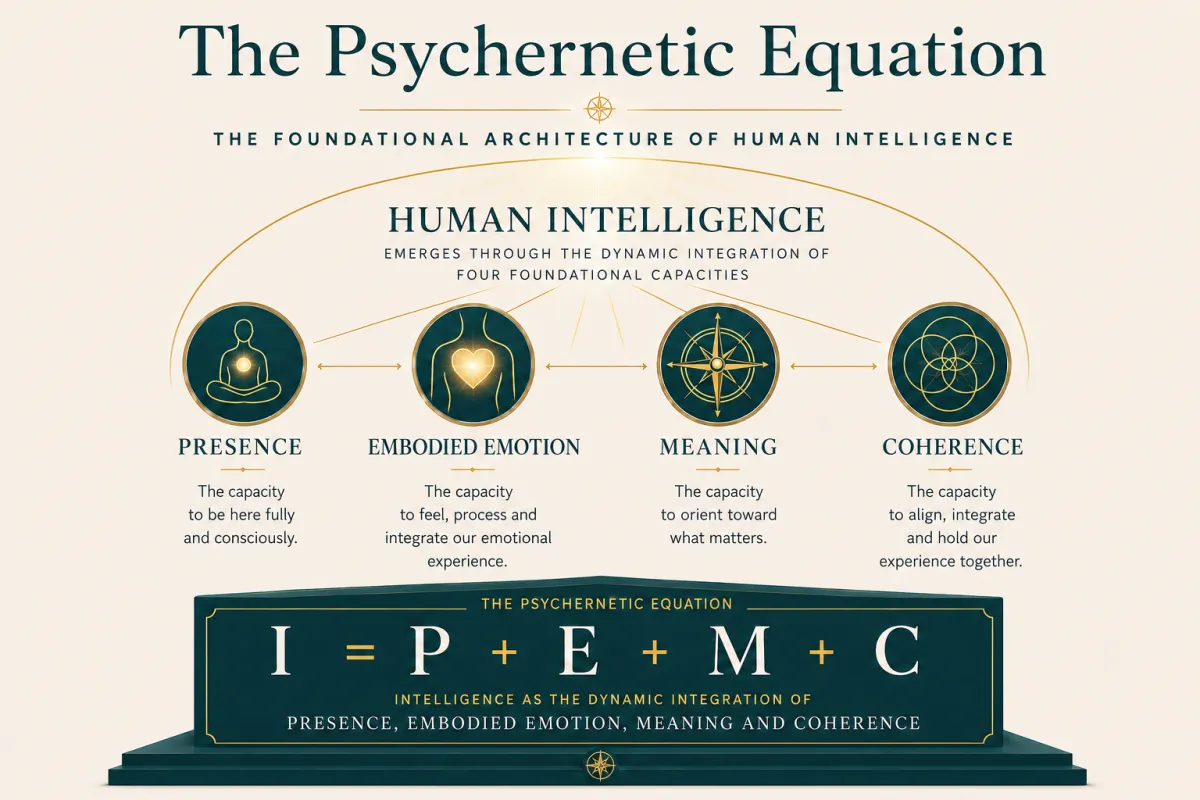
The Psychernetic Equation
At the foundation of Compass is the Psychernetic Equation, the foundational organising principle of Psychernetics.
Intelligence = Presence + Embodied Emotion + Meaning + Coherence
I = P + E + M + C
The Psychernetic Equation provides an architectural framework for understanding how intelligent functioning becomes organised and available in real time.
Rather than treating intelligence as a single trait or fixed capacity, it proposes that intelligent functioning emerges through the dynamic integration of four foundational capacities:
Presence makes us available to present reality rather than becoming lost within automatic reaction.
Embodied Emotion enables us to recognise and integrate the information carried within emotional experience.
Meaning keeps us oriented towards what genuinely matters.
Coherence integrates perception, emotion, meaning and action into deliberate response.
Compass has been designed to progressively strengthen the availability of this architecture.
Not by forcing change.
But by creating the conditions in which intelligent functioning can become increasingly reliable.
Human intelligence is not one isolated ability.
It emerges through the integration of presence, embodied emotion, meaning and coherence.
As that architecture becomes increasingly available, something important happens.
You stop experiencing life primarily as a series of reactions.
You begin navigating it with increasing clarity, stability and intention.
That developmental journey is what Compass was designed to support.
The pathway itself is deliberately structured.
Each stage builds the foundations required for the next, allowing development to unfold progressively rather than attempting to force transformation all at once.

The Compass Journey
Personal development often encourages people to change their lives immediately.
Compass takes a different approach.
Real development rarely happens through sudden transformation.
It happens through the gradual strengthening of capacities, where each stage creates the conditions that make the next stage possible.
For that reason, Compass has been designed as a progressive developmental pathway rather than a collection of independent modules.
Each stage builds upon what came before.
Nothing is rushed.
Nothing is skipped.
The journey moves from awareness towards increasingly stable participation in your own life, allowing intelligence to become progressively more organised, reliable and intentional.
This is not simply a sequence of lessons.
It is a structured progression through the architecture of human intelligence.
Recognition creates options. Options create agency.
Agency creates authorship.
The journey begins with a simple question.
Where am I?
Before meaningful change can occur, we first need to recognise where we are operating from.
From there, attention turns towards stabilisation.
Awareness becomes something we can sustain, even when life becomes demanding or emotionally activating.
Only then does orientation become possible.
Rather than reacting automatically, we begin recognising patterns, understanding context and seeing more clearly what is actually happening.
As perception becomes more reliable, authorship naturally emerges.
Decisions become less reactive and more closely aligned with values, intention and conscious participation.
Finally, integration transforms individual moments into an enduring way of living.
The capacities developed throughout Compass begin working together as a coherent whole.
The goal is no longer occasional clarity.
It is becoming someone who increasingly lives from it.
Development always begins quietly.
Capacity strengthens before confidence appears.
Stage Overview
Stage 1 – Locating
Where am I?
Developing awareness of your present experience and recognising the patterns from which you currently operate.
Stage 2 – Stabilising
Can I remain here?
Strengthening the capacity to remain present, regulated and reliable under internal and external pressure.
Stage 3 – Orienting
What is happening?
Learning to perceive systems, relationships and wider contexts with increasing clarity.
Stage 4 – Authorship
Who is leading?
Developing conscious agency by aligning perception, intention and action.
Stage 5 – Integration
Can I live from this consistently?
Allowing these capacities to become more deeply embodied as an enduring way of being.
By the time you complete Compass, you will have done far more than learn new ideas. You will have travelled through a carefully designed developmental pathway intended to strengthen the architecture through which those ideas become lived experience.
If you're ready to begin strengthening the architecture of your own intelligence ...
Lifetime access • Learn at your own pace • Certification included
Compass draws upon established psychology, philosophy, systems thinking and more than three decades of therapeutic practice.
But it does not stop there. It introduces an entirely new architecture for understanding and strengthening human intelligence.
It is here that Psychernetics begins to distinguish itself.

The Architecture of Psychernetics
One Architecture. One Discipline. One Integrated System.
Everything you have explored so far has been leading towards something larger.
Compass is more than a course.
It is the foundational developmental pathway into an entirely new discipline.
Throughout this page, you've encountered individual ideas, models and developmental principles.
Each contributes something important.
Only when they are seen together does the architecture become fully visible.
This is Psychernetics.
Compass is where the journey begins.
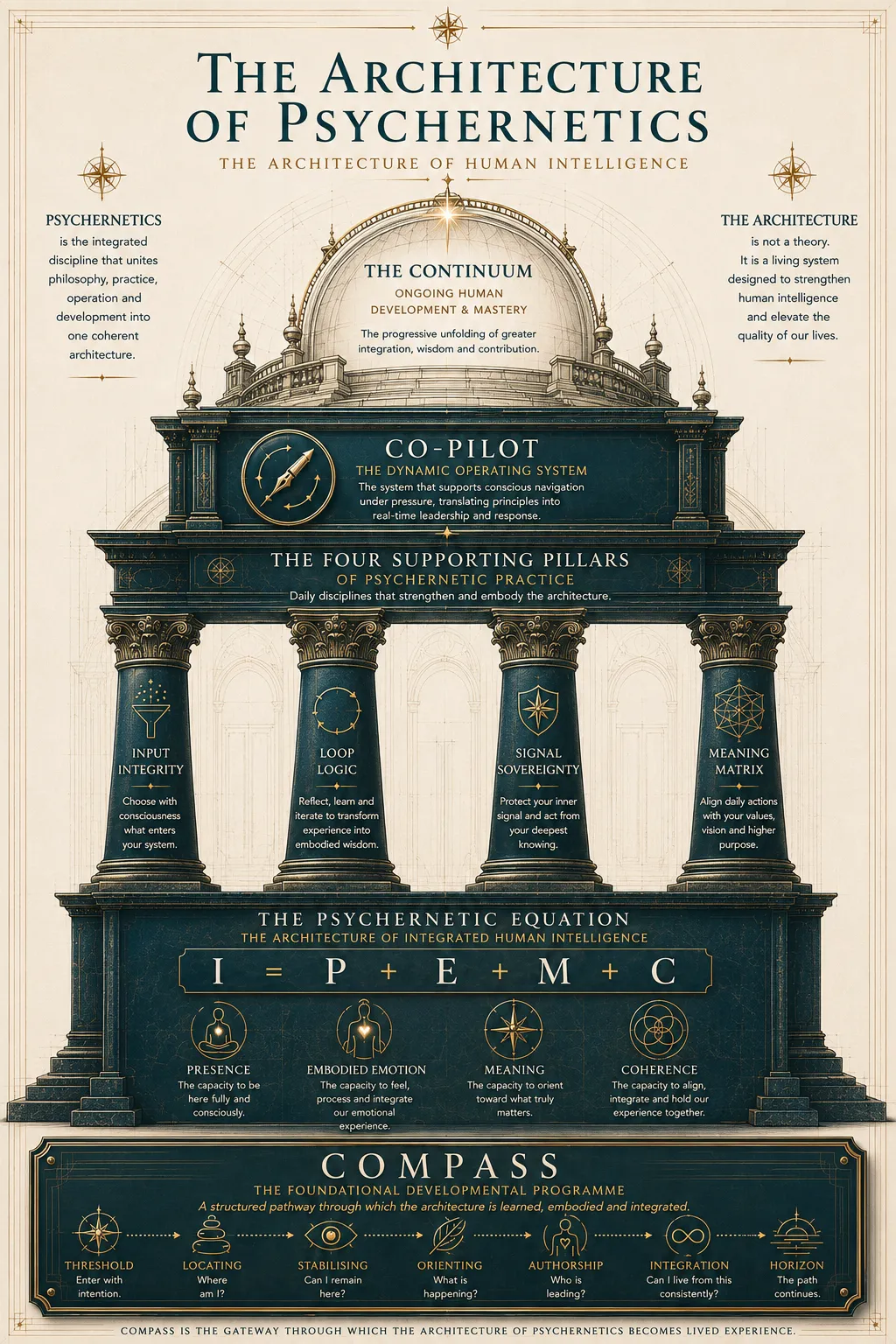
The complete Psychernetic architecture can now be seen as an integrated whole.
The Psychernetic Equation provides the foundational organising principle of Psychernetics, describing the architecture of intelligent functioning.
The Four Supporting Pillars of Psychernetic Practice are the disciplined practices through which that architecture is intentionally strengthened.
Co-PILOT translates those principles into a practical operating system for navigating moments of pressure, complexity and uncertainty.
The Continuum reminds us that development is never a destination, but an ongoing process of integration.
Together, they form one coherent discipline.
This is Psychernetics.
Compass is where that architecture becomes lived experience.
The moment the architecture becomes visible, human development can become intentional.

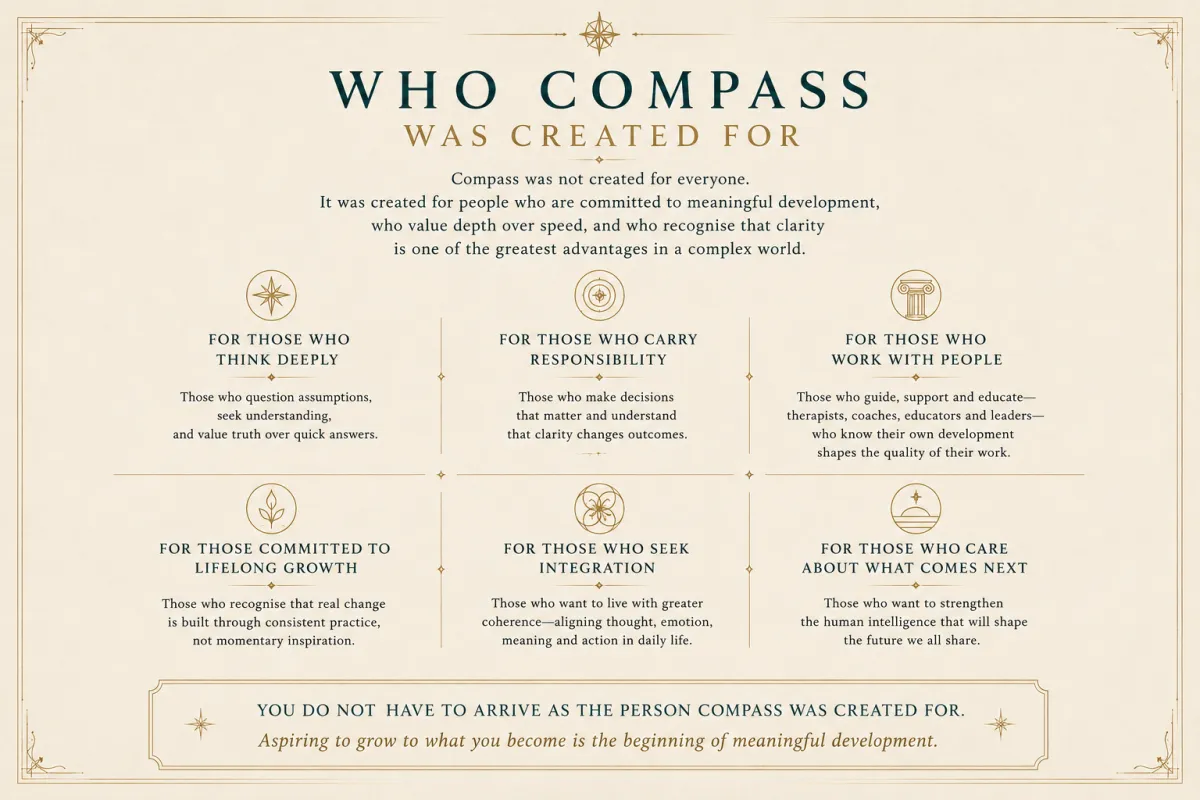
Who Compass Was Created For
Compass was not created for everyone.
It was created for people who believe that meaningful development requires more than information alone.
For those who value depth over speed.
For people who are willing to question themselves before questioning the world.
For professionals who understand that clearer thinking leads to better decisions.
For therapists, coaches, educators and leaders who recognise that the quality of their work depends upon the quality of their own orientation.
For lifelong learners who are prepared to practise rather than simply consume.
And for those who sense that becoming more intentional may be one of the most important forms of development in an increasingly automated world.
Every person you admire once stood where you are now.
The person they became was built one practice at a time.

An Architecture for Development
By now you've probably realised that Compass is different.
It doesn't promise a better version of you in thirty days.
It doesn't rely on motivation.
It doesn't offer hacks, shortcuts or life-changing secrets.
Instead, it offers something much quieter.
A disciplined way of strengthening the architecture through which every thought, every decision and every relationship is experienced.
Because lasting change rarely arrives through dramatic breakthroughs.
It arrives through small moments of increasing awareness, repeated consistently over time.
Eventually, something remarkable happens.
You stop trying to remember the framework.
You begin living from it.

Your Compass Experience
Compass is more than a collection of lessons.
It is an intentionally structured developmental journey, designed to strengthen human intelligence through practice.
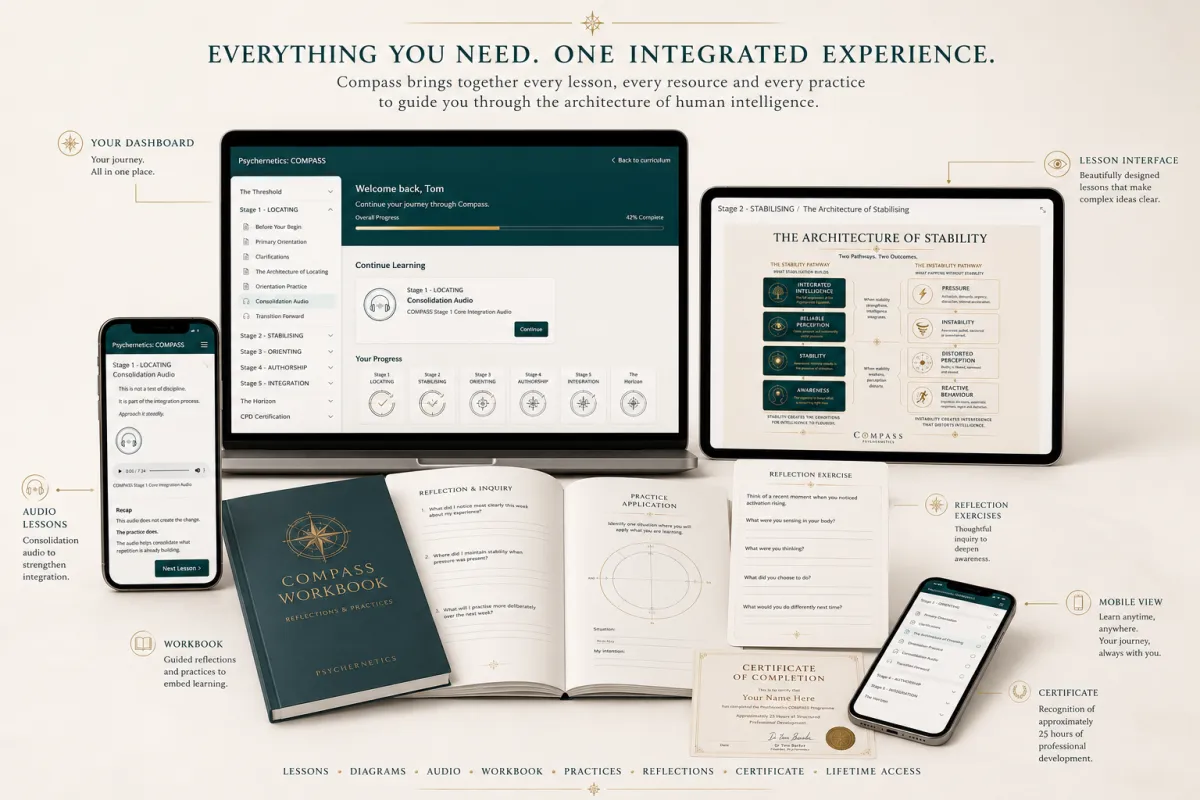
When you join Compass, you'll receive immediate lifetime access to the complete programme.
Including every lesson, every architectural diagram, every guided audio lesson, every reflective inquiry and every practical exercise developed specifically for the Psychernetics framework.
You'll also receive downloadable resources, future programme updates and a certificate of completion recognising 25 hours of structured professional development.
Everything has been intentionally designed as one integrated learning experience.
Nothing has been included simply to increase volume.
Every lesson, every exercise, every guided consolidation audio, and every reflective inquiry serves a single purpose: strengthening the capacities through which human intelligence becomes increasingly integrated and intentionally lived.
Designed for Real Life
Development does not happen only when you're sitting at a desk.
Compass has been designed to move with you, allowing you to continue your journey across desktop, tablet and mobile.
Whether you're watching a lesson, revisiting an architectural diagram, listening to a consolidation audio during a walk, or reflecting on a recent experience, every part of the programme remains available whenever the opportunity to practise arises.
Download the companion app for iOS or Android and continue your development wherever you are.
Technology delivers the programme. Your practice creates the development.


About Dr Tom Barber
Psychotherapist. Researcher. Educator. Author.
Founder of Psychernetics.

For more than thirty years, Dr Tom Barber has worked at the forefront of psychology, psychotherapy and human development, helping individuals, leaders and organisations better understand how people think, adapt, recover and make decisions under pressure.
Across those three decades he has trained thousands of psychological practitioners and professionals throughout the UK and internationally, delivered pioneering work in personality development across Europe, the United States, Russia and China, and conducted groundbreaking published research into the nature of human emotion.
His work has been recognised internationally, including an award for Outstanding Scientific Contributions to Psychology from the University of Constanta, and he has shared the stage with many of the world's leading thinkers in psychology, personal development and human potential.
Throughout that work, one conviction became increasingly clear: human intelligence is not fixed. The capacities that underpin clarity, judgement, discernment, emotional regulation and coherent decision-making can be intentionally strengthened.
As advances in artificial intelligence accelerated, that conviction took on a new urgency. If machines continue to become increasingly capable, then the intentional development of distinctly human intelligence becomes one of the defining challenges of our age.
That realisation led to the creation of Psychernetics.
Rather than offering another model of self-improvement, Psychernetics proposes a new way of understanding and developing human intelligence itself. Compass is the first practical developmental programme within that wider discipline, bringing together decades of clinical practice, research, teaching and real-world application into one coherent developmental pathway.
Dr Barber is the author of three #1 bestselling books, including Unmachine Your Mind, which introduces many of the foundational ideas explored more deeply throughout Compass.
As Featured in





What People Are Saying About Psychernetics
The Psychernetics framework was first introduced through Unmachine Your Mind.
Compass builds on that foundation, transforming the underlying principles into a structured developmental journey that can be experienced, practised and integrated into everyday life.
These reflections are from readers whose first encounter with Psychernetics began in the book.


Urgently Needed
"A way to take back control of our own minds. A timely reminder that staying sharp and fully human in the age of AI is a conscious choice."
– Theo van Dort - Bali
Founder of Communitee.AI

Hard-Won Wisdom
"This isn’t armchair philosophy; it’s wisdom that lands in the body. A powerful reminder that depth is something the machine cannot replicate."
– Gill Moakes - UK
International Business Coach & Leadership Mentor

Profoundly Uplifting
“A timely and urgent vision for the age of artificial intelligence. A guide to reclaiming presence in a world determined to automate it.”
– Raymond Aaron - Canada
New York Times Bestselling Author

On Staying Human
“A reminder of what it means to think for ourselves and why protecting the human mind has never mattered more.”
– Alicia Eaton - UK
Behavioural Change Psychotherapist & Author

A Timely Reminder
"A timely reminder to rise above the algorithms and not allow AI to deprive us of the things that make us so deliciously human."
– Sandy Davies - UK
Former Headteacher & Senior Leadership Trainer
The Human Edge
“The essential wake-up call every entrepreneur needs in the AI era. A powerful reminder to protect our human edge.”
– Anwar Craven - Bali
Founder of Communitee.AI

Frequently Asked Questions
What is Psychernetics?
Psychernetics is the study and practice of strengthening human intelligence. It explores how Presence, Embodied Emotion, Meaning and Coherence work together to shape perception, judgement and decision-making. Compass is the practical foundation programme that introduces this framework through structured experience rather than theory alone.
What is Compass?
Compass is the first developmental programme created within Psychernetics. Rather than teaching techniques to memorise, it guides you through a structured process of learning how to orient yourself more clearly in everyday life, helping you develop the habits and capacities that underpin clear thinking, emotional stability and intentional action.
Is Compass an online course?
Yes. Compass is a fully online, self-paced programme consisting of professionally produced video lessons, written teaching, practical exercises, downloadable resources and reflection materials. You can complete it in your own time and revisit the content whenever you wish.
Is Compass suitable for professionals and leaders?
Absolutely. Although Compass is accessible to anyone willing to engage thoughtfully, many of its principles are particularly valuable for leaders, therapists, coaches, educators, healthcare professionals and anyone whose work depends upon sound judgement, emotional regulation and clear decision-making.
Do I need to read Unmachine Your Mind first?
No. Compass stands entirely on its own. However, many people choose to read Unmachine Your Mind alongside the programme because the book introduces the wider philosophy and architecture of Psychernetics, while Compass transforms those ideas into practical developmental experience.
Is Psychernetics therapy?
No. Psychernetics is not psychotherapy, counselling or mental health treatment. It is a developmental framework concerned with strengthening human intelligence, improving orientation and cultivating greater clarity, coherence and intentional living. While many therapists and psychologists find it valuable, it is not a substitute for professional mental health care where that is needed.
How long does Compass take to complete?
Most participants complete Compass over several weeks, allowing time to apply each stage in everyday life before progressing. While the programme contains 25 hours of CPD-recognised learning, there is no fixed timetable. Compass is designed to be experienced rather than rushed.
Is there a certificate of completion?
Yes. Participants receive a digital Certificate of Completion after successfully completing the programme.
Will I have lifetime access?
Yes. Once enrolled, you have lifetime access to Compass, including future updates made to the programme.
Is Compass accredited?
Compass has been approved for approximately 25 hours of Continuing Professional Development (CPD). It is not a professional qualification or licensing programme. Its purpose is personal and professional development through the practical application of Psychernetics.
Is Compass right for me?
Compass was created for people who want to think more clearly, respond rather than react, navigate complexity with greater confidence and strengthen the uniquely human capacities that become increasingly important in an AI-mediated world. If you are looking for quick motivational techniques or instant transformation, it is probably not the right programme. If you are willing to engage thoughtfully and practise consistently, Compass was designed for you.
Where should I begin if I'm completely new to Psychernetics?
Compass was designed to be the ideal starting point.
Whether you've discovered Psychernetics through Unmachine Your Mind, an article, a podcast or simply through an interest in strengthening your own thinking, Compass provides the structured pathway into the framework.
You do not need any previous knowledge. Each stage builds naturally on the one before it, introducing the principles of Psychernetics through practical experience rather than information alone.
For most people, Compass is where the journey begins.
Still have a question? We'd be happy to help. Simply get in touch and we'll answer any questions you may have before you enrol.

The Architecture is Only the Beginning

Over the course of this page, you've explored a different way of understanding human intelligence.
A framework that asks not simply what we know, but how we perceive, orient, decide and live.
But architecture only becomes meaningful when someone steps inside it.
Compass was created for that purpose.
More than explaining Psychernetics.
Its purpose is to help you live it.
The next step isn't to read more about Psychernetics.
It's to experience it for yourself.
If you're ready, click below and begin your Compass journey.
Compass is now open. Begin your journey into the architecture of human intelligence.

Psychernetics develops applied human intelligence for an AI-mediated world. Grounded in psychology and systems thinking, it restores clarity, composure, and internal sovereignty under pressure. This is not motivation. It is architecture. Reclaim authorship. Think deeper. Lead deliberately.
CONTACT US
+44 (0)204 5424497
Psychernetics Ltd
71-75 Shelton Street
Covent Garden
London, WC2H 9JQ
Opening Hours: Monday till Friday 09.00 to 17.00
LEGAL INFORMATION


Copyright 2026 Psychernetics Ltd. All rights reserved. Psychernetics® is a registered trademark of Dr Tom Barber.