
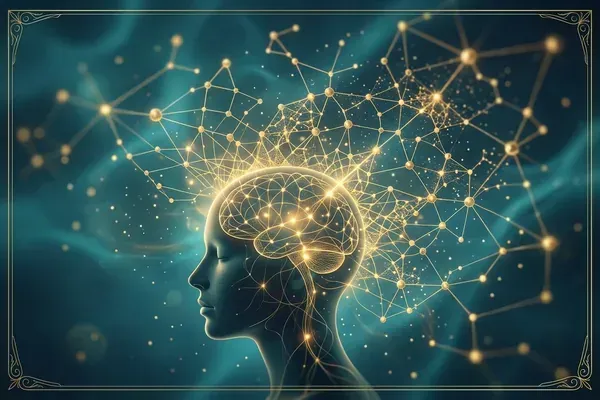
Neurodivergence, Pattern Recognition, and the Future of Human Intelligence
The Minds That Do Not Follow Standard Patterns May Be The Ones That Are Best Equipped
Some minds do not process the world in standard sequence.
They move through pattern before explanation, intensity before simplification, association before linear order.
What has often been described clinically as divergence may increasingly become one of the most valuable forms of intelligence in an age shaped by complexity.
This is especially true as artificial intelligence changes what counts as useful cognition.
The future may belong less to those who fit conventional processing norms, and more to those who perceive differently enough to notice what others miss.
To explore how intelligence itself is being redefined, see the Psychernetics framework.
Why Neurodivergent Thinking Matters More Now
Many digital systems reward rapid sorting, repetition, and predictable response.
Yet the problems emerging in modern life are increasingly non-linear.
They involve multiple systems interacting at once: technology, psychology, ethics, culture, economics, and identity.
Pattern recognition becomes critical here.
Many neurodivergent people naturally detect relationships across apparently unrelated domains more quickly than conventional models predict.
This can appear unusual in ordinary environments, yet become highly valuable in complex ones.
This form of perception often reflects a deeper level of integrated understanding, sometimes described as “grokking”, explored further in What Does It Mean to “Grok”?
ADHD and Associative Intelligence
Many people with traits associated with Attention Deficit Hyperactivity Disorder describe rapid associative movement.
Thought does not always proceed step by step. It often leaps.
This can create difficulty in highly constrained systems, yet also enables original linkage across ideas.
When supported properly, this kind of mind often sees possibilities early.
This form of associative thinking is explored further in Why Embodiment Matters More Than Ever in a Digital World.
Autism and Precision of Perception
Many people with traits associated with Autism spectrum disorder often bring an unusual depth of focus, precision, and sensitivity to pattern consistency.
What others dismiss as detail may in fact be a structural signal.
This becomes increasingly valuable wherever complexity must be understood carefully rather than socially glossed over.
Why AI Makes Human Difference More Visible
AI increasingly handles conventional summarising well.
That means distinctive human cognition becomes easier to notice.
Original perception, unusual synthesis, and non-standard framing stand out more when routine outputs become automated.
This creates an important shift: what once looked inefficient in traditional systems may become highly valuable in future environments.
This shift is part of a broader change in how thinking itself is being shaped. More insights into that can be found in Why Human Intelligence Still Matters in the Age of AI.
Neurodivergence and the Question of Human Intelligence
The deeper issue is not diagnosis alone.
It is whether society understands intelligence narrowly or broadly.
A narrow model rewards conformity of processing.
A broader model recognises that some minds generate insight precisely because they do not stabilise in ordinary ways.
This connects directly to the idea of cognitive sovereignty.
The Psychernetic Equation provides one architectural way of understanding how these interacting capacities influence human cognition.
The Leadership Implication
Organisations increasingly need people who can detect emerging patterns before they become obvious.
That often includes minds that notice anomalies, inconsistencies, and hidden relationships early.
The future of human intelligence may therefore depend partly on protecting forms of cognition that standard systems have often misunderstood.
A More Honest View of Strength and Difficulty
None of this romanticises struggle.
Neurodivergent people often carry real friction: overload, exhaustion, misfit, and misunderstanding.
But difficulty and value frequently coexist.
A mind may be harder to regulate and also unusually gifted in perception.
The mature question is not whether divergence creates challenge. It clearly can.
The better question is whether environments are learning to recognise the intelligence within them.
Why This Fits the Future of Human Intelligence
As the world becomes more synthetic, original human pattern recognition becomes increasingly valuable.
Not all intelligence will look calm, linear, or conventionally organised.
Some of the minds best suited to future complexity may be those once described simply as difficult.
You can explore this more deeply in Unmachine Your Mind.
FAQ
Is neurodivergence an advantage in the age of AI?
In many contexts, it can be, particularly where original pattern recognition matters.
Why are ADHD traits linked to creativity?
Because rapid associative movement often enables unusual idea linkage.
Does autism support future-oriented thinking?
Often yes, particularly where depth, consistency, and structural attention matter.
Is conventional intelligence still enough?
Routine intelligence remains useful, but future complexity increasingly rewards broader cognitive diversity.
The Future of Human Intelligence
Psychernetics explores how human intelligence, including neurodivergent intelligence, can remain distinct and valuable in a rapidly changing technological world.
To understand the full framework, visit the Psychernetics model.
These ideas sit within the broader framework of Psychernetics, a system designed to help individuals think with greater clarity, depth, and independence in the age of artificial intelligence.
The foundations of this work are explored in Unmachine Your Mind, where the relationship between human intelligence and modern technological environments is examined in greater depth.
Further insights can be found in the Insights series.