
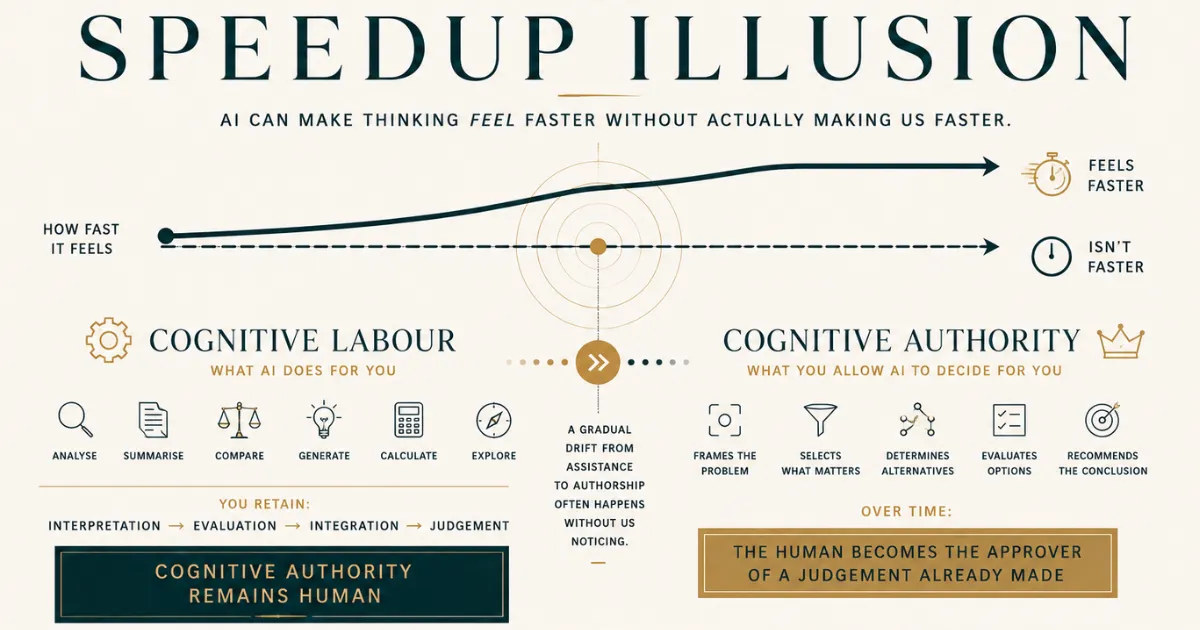
The Speedup Illusion: What Happens to Human Judgement When AI Makes Thinking Feel Easier?
The emerging challenge may not be whether artificial intelligence can think for us, but whether we can still tell when we are thinking well ourselves.
One of the most interesting findings I have encountered recently about artificial intelligence has very little to do with what AI can actually do.
It concerns what we believe it is doing for us.
A large preregistered behavioural study by Yu and colleagues (2026), published as a preprint in May 2026, examined what happened when people used artificial intelligence to help them complete a range of relatively straightforward cognitive tasks. The researchers worked with 1,237 participants across activities involving information seeking, synthesis, procedural guidance and content creation. Some were asked to estimate how long they thought the tasks would take with and without AI, while others actually completed them.
What emerged was fascinating.
People expected AI to make them significantly faster. For many of the tasks, however, it didn't.
Participants were remarkably good at estimating how long tasks would take when working independently. Once AI became involved, that accuracy deteriorated. They systematically underestimated how long AI-assisted tasks would take, creating what the researchers called the speedup illusion.
I find this interesting because another finding emerged alongside it. Although AI assistance did not reduce completion time overall, it did reduce how mentally effortful the work felt.
People were not necessarily working faster. They were experiencing themselves as working more easily.
There is a subtle but important distinction here, particularly as artificial intelligence becomes woven into more of our everyday cognitive activity. If something feels easier, we can understandably experience ourselves as becoming more efficient. If we feel more efficient, it is only a small step towards assuming that the quality of our thinking has improved as well.
Yet these things are not necessarily the same.
The question raised by the research is therefore larger than whether AI saves us time. It concerns whether our subjective experience of thinking remains a reliable guide to what is actually happening cognitively.
When Thinking Feels Faster
Human beings have always offloaded cognition. We write things down so that we do not have to remember everything. We use calculators rather than performing every calculation mentally. We consult maps, books, search engines, experts and, of course, one another.
There is nothing inherently problematic about this. Cognitive offloading is often an extremely intelligent use of limited human resources, and refusing to use external tools would hardly constitute evidence of superior intelligence.
Artificial intelligence introduces something rather different, however, because it can participate much further upstream in the thinking process.
A calculator performs a relatively narrow operation. A notebook stores information. A conventional search engine helps us locate information. Generative AI can summarise material we have not read, formulate arguments we have not constructed, compare positions we have not examined, generate alternatives we have not imagined and recommend conclusions we have not reached ourselves.
This makes the question of what we choose to offload considerably more interesting.
In the speedup illusion study, participants expected AI assistance to save around 68 seconds compared with completing tasks independently. In reality, AI-assisted completion was almost a minute longer than they had predicted. Across the easier tasks there was no significant overall speed advantage from using AI, although measurable improvements did appear on some of the more demanding tasks.
What may be more revealing is what happened to people's experience of the work.
AI reduced reported mental effort by an average of 0.61 points on a seven-point workload scale, with significant reductions appearing across 15 of the 24 tasks studied. The researchers suggest that this reduction in subjective effort may partly explain why participants believed they were saving more time than they actually were.
The task felt easier, and that feeling appears to have influenced their judgement of their own performance.
This leaves us with a psychological question that I suspect will become increasingly important: what happens when we begin to confuse the reduction of cognitive effort with an improvement in cognitive performance?
The implications extend considerably beyond productivity.
They reach into judgement itself.
The Hidden Importance of Cognitive Friction
We have become accustomed to thinking of friction as something technology should remove, and in many areas of life that has clearly been beneficial. Much of human progress has involved finding ways to reduce unnecessary labour and free our time and attention for other things.
Cognitive friction, however, is not always unnecessary friction.
Anyone who has spent serious time writing will recognise this. Sometimes the difficulty of articulating an idea is precisely what reveals that we do not yet understand it properly. We begin a sentence convinced that our thinking is clear and discover, halfway through writing it, that it isn't.
The same thing happens in conversation, research and decision-making. Contradictory evidence forces us to examine assumptions. Uncertainty makes us look again. Disagreement exposes weaknesses in conclusions that initially appeared perfectly reasonable. Sometimes the uncomfortable sense that something does not quite fit is the beginning of much better thinking.
The difficulty is not simply an obstacle standing between us and the answer. At times, working through that difficulty is part of how the answer becomes intelligible to us.
This matters particularly when decisions are complex enough that there is no single objectively correct output.
Consider a chief executive contemplating a significant organisational restructuring. There may be financial projections, market data, employee consequences, competing strategic priorities, previous experience, ethical considerations, advice from colleagues, pressure from investors and perhaps an uneasy feeling that something within the proposal does not yet quite fit.
Artificial intelligence could contribute enormously to such a process. It could model scenarios, interrogate assumptions, identify patterns, summarise evidence and generate competing interpretations.
What it cannot remove is the need to organise all of this into a judgement.
And it is here that I think we reach something more fundamental about human intelligence.
Coherence and Human Judgement
Within Psychernetics, I use the term Coherence to describe one of the four fundamental capacities involved in integrated human intelligence.
I do not mean by this that everything must be neatly resolved, or that an intelligent person should always feel certain and internally consistent. In fact, some of the most coherent thinking I encounter is thinking that remains genuinely uncertain because the available evidence does not justify certainty.
Coherence concerns the capacity to bring different forms of information into a sufficiently organised relationship that intelligent judgement remains possible.
A person can possess extraordinary knowledge without necessarily possessing Coherence. They may have accurate information while failing to recognise its relative importance. They may understand the data while overlooking emotional information that is signalling something significant. They may hold several individually reasonable ideas without noticing that those ideas contradict one another, or accept a persuasive conclusion before considering whether it makes sense within the wider context in which the decision has to live.
As artificial intelligence increases the amount of analysis available to us, this integrative capacity becomes more important, not less.
We are rapidly approaching a world in which generating another interpretation, another summary, another prediction or another possible solution is rarely the difficult part. The difficulty increasingly lies in determining what deserves our attention, what can be trusted, what matters in this particular context and how apparently conflicting forms of information should be held together.
That is a problem of Coherence.
Offloading the Task Without Offloading Judgement
Some recent research offers a useful way of thinking about this.
A study by Zhu and colleagues (2026), published in Frontiers in Psychology in July 2026, distinguishes between dependent cognitive offloading and autonomous cognitive offloading when people work with generative AI.
In dependent offloading, a person increasingly allows the system to perform not only parts of the task but aspects of the governing cognitive process itself. The AI begins to determine what information matters, which perspectives deserve consideration and which conclusion should be reached. The researchers describe the possibility of cognitive agency transfer, where some of the authority for directing cognition gradually moves towards the external system.
Autonomous offloading looks rather different. Someone may still make extensive use of AI, but they remain actively involved in directing the process. They compare its output with their own reasoning, use it to generate alternatives, test assumptions, challenge conclusions and integrate what is useful into thinking for which they remain responsible.
I think this distinction is considerably more helpful than the increasingly tired debate about whether using AI is somehow good or bad for us.
The more interesting question is: who is organising the thinking?
The Frontiers study found that dependent offloading was associated with greater transfer of cognitive agency and lower intrinsic motivation, while autonomous offloading was associated with preserved motivation and more favourable perceived cognitive outcomes.
The researchers are appropriately cautious about the findings because the design provides correlational rather than causal evidence, but the pattern is nevertheless worth paying attention to.
There was another detail that particularly interested me.
Both forms of offloading could feel beneficial in the moment. Immediate perceived benefit did not reliably tell participants which form of AI use was associated with better subsequent cognitive outcomes.
We therefore encounter the same problem that appeared in the speedup illusion.
Our subjective experience may not always tell us what is actually happening to our thinking.
Something can feel easier without making us faster, just as something can feel productive without necessarily preserving our capacity to think independently.
Confidence, AI and the Changing Location of Thought
Research involving knowledge workers points towards a similarly nuanced picture.
A Microsoft Research study by Lee and colleagues (2025), presented at CHI 2025, surveyed 319 professionals and gathered 936 examples of people using generative AI in real work. What interests me about this research is that it did not find that AI simply removed critical thinking. Instead, the location of critical thinking appeared to change.
People increasingly found themselves verifying information, integrating AI responses and overseeing tasks rather than generating everything independently.
This is an important distinction. There is little value in romanticising the effort involved in doing something ourselves when a tool can perform part of that work perfectly well. Human development has never depended upon making every task as cognitively expensive as possible.
But the Microsoft research also found an interesting relationship with confidence. The more confidence people had in the AI, the less critical thinking they reported engaging in. Conversely, the more confidence they had in their own ability to perform the task, the more critical thinking they reported applying.
This does not suggest that we should distrust artificial intelligence. It suggests that trust itself needs to remain calibrated.
The danger is not confidence in the tool. It is confidence becoming detached from active judgement.
Seen this way, the speedup illusion becomes more than an interesting finding about productivity. Participants were relatively good at estimating their own performance when working independently, but became less accurate once AI entered the cognitive system.
They were no longer simply judging themselves.
They were judging the performance of a new human-machine cognitive arrangement of which they had become part.
And they were not yet particularly good at doing so.
We are Already Entering the Age of Delegated Judgement
This question becomes more pressing as AI moves beyond relatively contained productivity tasks and further into consequential areas of everyday life.
An August 2026 preprint by Bilal and colleagues (2026), examining 1.5 million real-world ChatGPT and Gemini interactions from 6,304 users, found that people are already making substantial use of AI around financial decisions.
Most were not handing control of their money over to AI entirely. Direct delegation of financial execution remained rare.
What people were doing, however, was using AI not only to retrieve information but increasingly to help shape financial judgement.
I suspect that this middle territory is where much of our future relationship with artificial intelligence will develop.
There is an enormous space between asking a machine for information and allowing it to make a decision for us. Within that space, AI can propose, interpret, prioritise, summarise, compare, predict and recommend while leaving the final decision apparently in human hands.
The word apparently matters.
Because if a system has already selected the information, framed the alternatives, identified what it considers significant and recommended the preferred conclusion, we need to ask how much of the judgement genuinely remains ours.
The answer will not always be the same.
But we should at least be asking the question.
Coherence in the Age of Artificial Intelligence
This is one of the reasons I believe we need to reconsider what we mean when we talk about human intelligence.
For more than a century, discussions of intelligence have concentrated heavily upon what a person is capable of doing: remembering, reasoning, calculating, solving problems, manipulating information and recognising patterns.
Artificial intelligence increasingly performs many of these operations astonishingly well.
What interests me is another dimension of intelligence that becomes much more visible once machines can perform so much of the cognitive work around us.
It is not simply how much intelligence is available to a person, but how well that intelligence remains organised when judgement is required.
Within the Psychernetic model, Coherence sits alongside three other capacities: Presence, Embodied Emotion and Meaning.
Presence concerns whether we are sufficiently here to perceive what is actually happening rather than merely responding to the representations placed before us. Embodied Emotion concerns our ability to recognise emotional information and integrate it intelligently rather than either being unconsciously driven by it or excluding it from consideration. Meaning concerns the interpretive structures through which events acquire significance. Coherence brings these different streams of information into relationship.
Together, these capacities point towards a conception of intelligence that extends beyond cognitive horsepower.
This is not an argument for becoming less technological. I use artificial intelligence extensively myself, and I find its possibilities extraordinary.
The question is how we use it without quietly surrendering the human capacities that allow us to judge what it gives us.
The Distinction That May Matter Most
We are going to offload more cognition to artificial intelligence.
I think that is inevitable, and much of it will be enormously beneficial.
The distinction I find increasingly useful is therefore not between using AI and refusing to use it. It is between offloading cognitive labour and offloading cognitive authority.
I can ask AI to generate ten objections to an argument while remaining responsible for deciding whether any of them are persuasive. I can ask it to summarise a hundred pages while remembering that the summary is an interpretation rather than the material itself. I can ask it to expose weaknesses in my thinking without asking it to decide what I should think.
Used in this way, artificial intelligence can widen the cognitive field rather than close it.
The responsibility for organising that field, however, remains mine.
That may become one of the central disciplines of Coherence in the years ahead.
And perhaps this is why I find the speedup illusion so fascinating.
It reveals something easily overlooked amid the extraordinary capabilities of the technology. Artificial intelligence can make thinking feel easier, and sometimes it genuinely will make us faster, more informed and better able to see possibilities that would otherwise remain invisible.
But the feeling of ease tells us very little, by itself, about the quality of the thinking taking place.
As AI becomes increasingly capable, our task may therefore be more subtle than protecting human intelligence from machines.
We may need to become better at recognising when our own intelligence remains actively present within the systems we increasingly think alongside.
Because the defining question may no longer be whether artificial intelligence can think.
It may be whether, in its presence, we can remain coherent enough to know when we still are.
References & Further Reading
Yu, S., Cheng, M., Jabbar, A., Sucholutsky, I., Collins, K. M., Jurafsky, D., & Hawkins, R. D. (2026). Cognitive offloading and the speedup illusion in human-AI interaction. arXiv. https://doi.org/10.48550/arXiv.2605.23177
Zhu, Q., Li, X., Dong, Y., Chang, P., & Fan, M. (2026). Not all cognitive offloading is equal: Distinguishing dependent and autonomous offloading to generative AI. Frontiers in Psychology, 17, 1878629. https://doi.org/10.3389/fpsyg.2026.1878629
Lee, H.-P., Sarkar, A., Tankelevitch, L., Drosos, I., Rintel, S., Banks, R., & Wilson, N. (2025). The impact of generative AI on critical thinking: Self-reported reductions in cognitive effort and confidence effects from a survey of knowledge workers. In Proceedings of the 2025 CHI Conference on Human Factors in Computing Systems (Article 1121, pp. 1–22). Association for Computing Machinery. https://doi.org/10.1145/3706598.3713778
Bilal, I. M., Wang, Y. C., Raj, A., Giovagnini, F., Tewari, P., Zhang, Y., Liou, M.-C. Z., & Zaman, Q. (2026). From information to delegation: Mapping human-AI financial decision making. arXiv. https://doi.org/10.48550/arXiv.2608.02100